
Ch.1 - Introduction: Matter, Energy, and Measurement
Brown - Chemistry: The Central Science 15th Edition
Brown15th EditionChemistry: The Central ScienceISBN: 9780137542970Non è quello che usi tu?Cambia libro di testo
Capitolo 1, Problema 23c

Label each of the following as either a physical process or a chemical process: c. pulverizing an aspirin

Guida verificata passo dopo passo
1
Identify the nature of the process involved with the aspirin. Pulverizing means to crush or grind something into a powder or dust.
Understand the difference between physical and chemical processes. A physical process involves a change in the physical state or properties of a substance without a change in its chemical composition.
Determine if the chemical structure of the aspirin changes when it is pulverized. Pulverizing affects the size and shape but not the chemical identity of the aspirin.
Compare this to a chemical process, where there is a change in the chemical composition and new substances are formed.
Conclude whether pulverizing an aspirin is a physical or chemical process based on whether the chemical structure of the aspirin is altered.

Risposta video verificata per un problema simile:

Questa soluzione video è stata consigliata dai nostri tutor come utile per risolvere questo problema.
Durata del video:
1m

Concetti chiave

Ecco i concetti essenziali che devi comprendere per rispondere correttamente alla domanda.

Physical Process

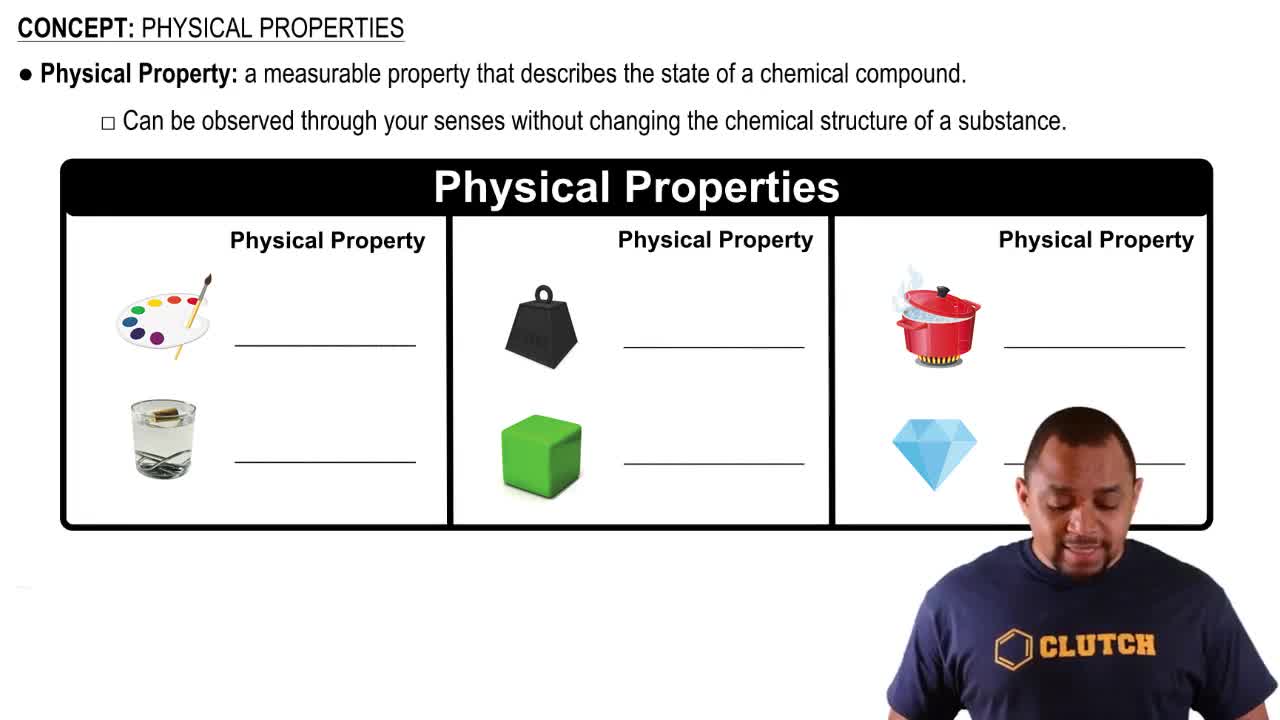
A physical process involves changes in the state or appearance of a substance without altering its chemical composition. Examples include phase changes like melting or boiling, as well as mechanical processes like grinding or pulverizing. In these cases, the substance retains its original chemical identity.
Video consigliato:
Percorso guidato
02:54
Physical Properties

Chemical Process

A chemical process involves a transformation that changes the chemical composition of a substance, resulting in the formation of new substances. This can include reactions such as combustion, oxidation, or synthesis, where the original materials undergo a chemical change and cannot be easily reverted to their original form.
Video consigliato:
Percorso guidato
01:34
Chemical Properties Example

Pulverizing

Pulverizing refers to the mechanical process of breaking down a substance into smaller particles or powder. In the case of aspirin, pulverizing does not change its chemical structure; it simply alters its physical form, making it easier to dissolve or mix with other substances. Thus, it is classified as a physical process.
Pratica correlata
Domanda del libro di testo

For each of the following processes, would filtration, distillation, or chromatography be the most effective separation technique:

a. removing the pulp from freshly squeezed orange juice,

b. separating a food dye into its individual components,

c. desalinating seawater?

1
views
Domanda del libro di testo

(b) Which properties of zinc can you describe from the photo? Are these physical or chemical properties?

511
views
Domanda del libro di testo

Label each of the following as either a physical process or a chemical process: b. boiling a cup of water

5
views
Domanda del libro di testo

A silvery metal is put inside a beaker of water. Bubbles form on the surface of the metal and it dissolves gradually. (a) Is this an example of a chemical or a physical change?

692
views
Domanda del libro di testo

A match is lit and held under a cold piece of metal. The following observations are made: (a) The match burns. (b) The metal gets warmer. (c) Water condenses on the metal. (d) Soot (carbon) is deposited on the metal. Which of these occurrences are due to physical changes, and which are due to chemical changes?

871
views
Domanda del libro di testo

(a) Read the following description of the element zinc and indicate which are physical properties and which are chemical properties. Zinc melts at 420 °C. When zinc granules are added to dilute sulfuric acid, hydrogen is given off and the metal dissolves. Zinc has a hardness on the Mohs scale of 2.5 and a density of 7.13 g/cm3 at 25 °C. It reacts slowly with oxygen gas at elevated temperatures to form zinc oxide, ZnO.

866
views