

Ch.10 - Gases
Brown - Chemistry: The Central Science 15th Edition
Brown15th EditionChemistry: The Central ScienceISBN: 9780137542970Non è quello che usi tu?Cambia libro di testo
Capitolo 10, Problema 44c

Many gases are shipped in high-pressure containers. Consider a steel tank whose volume is 55.0 gallons that contains O2 gas at a pressure of 16,500 kPa at 23°C. c. At what temperature would the pressure in the tank equal 150.0 atm?

Guida verificata passo dopo passo
1
First, we need to convert all the given quantities into SI units. The volume of the tank is given in gallons, which should be converted to liters (1 gallon = 3.78541 liters). The pressure is given in kPa, which should be converted to atm (1 atm = 101.325 kPa). The temperature is given in Celsius, which should be converted to Kelvin (K = °C + 273.15).
Next, we can use the ideal gas law equation, PV = nRT, where P is the pressure, V is the volume, n is the number of moles of gas, R is the ideal gas constant, and T is the temperature. However, since we are not given the number of moles of gas, we can use the fact that the number of moles of gas is constant (since the amount of gas in the tank doesn't change) to modify the equation to P1V1/T1 = P2V2/T2, where the subscripts 1 and 2 refer to the initial and final states, respectively.
Since the volume of the tank doesn't change, we can simplify the equation to P1/T1 = P2/T2.
Now, we can solve for the final temperature, T2. Rearranging the equation gives T2 = P2 * T1 / P1.
Finally, substitute the given values into the equation to find the final temperature. Remember to use the converted values for pressure and temperature.

Risposta video verificata per un problema simile:

Questa soluzione video è stata consigliata dai nostri tutor come utile per risolvere questo problema.
Durata del video:
2m

Concetti chiave

Ecco i concetti essenziali che devi comprendere per rispondere correttamente alla domanda.

Ideal Gas Law

The Ideal Gas Law is a fundamental equation in chemistry that relates the pressure, volume, temperature, and number of moles of a gas. It is expressed as PV = nRT, where P is pressure, V is volume, n is the number of moles, R is the ideal gas constant, and T is temperature in Kelvin. This law allows us to predict how changing one of these variables affects the others, making it essential for solving gas-related problems.
Video consigliato:
Percorso guidato
01:15
Ideal Gas Law Formula

Pressure Conversion

Pressure is often measured in different units, such as atmospheres (atm), pascals (Pa), or kilopascals (kPa). To solve problems involving gas laws, it is crucial to convert pressures to a consistent unit. For instance, 1 atm is equivalent to 101.325 kPa, so understanding how to convert between these units is necessary for accurate calculations in gas law applications.
Video consigliato:
Percorso guidato
02:20
Pressure Conversion Example

Charles's Law

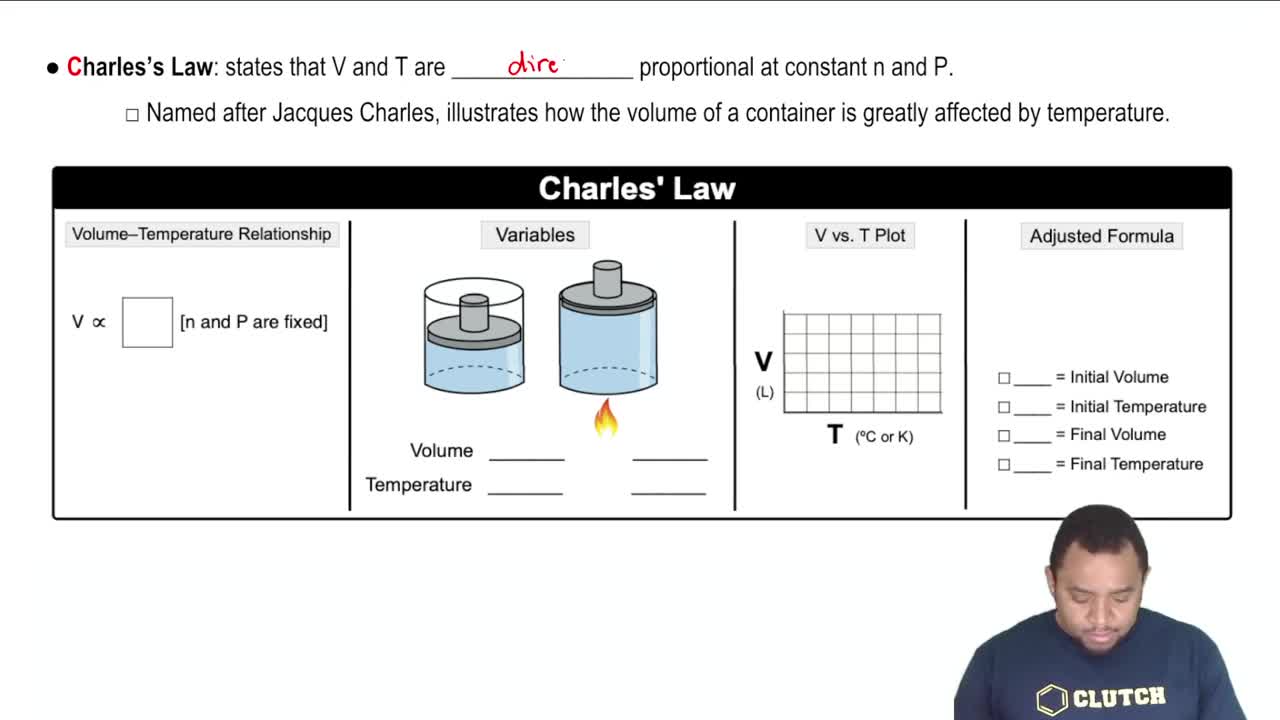
Charles's Law states that the volume of a gas is directly proportional to its temperature when pressure is held constant. This relationship can be expressed as V1/T1 = V2/T2. Although the question involves pressure changes, understanding this law helps in grasping how temperature affects gas behavior, particularly when manipulating the Ideal Gas Law to find unknown temperatures.
Video consigliato:
Pratica correlata
Domanda del libro di testo

Chlorine is widely used to purify municipal water supplies and to treat swimming pool waters. Suppose that the volume of a particular sample of Cl2 gas is 8.70 L at 895 torr and 24°C. c. At what temperature will the volume be 15.00 L if the pressure is 8.76×10² torr?

Domanda del libro di testo

Chlorine is widely used to purify municipal water supplies and to treat swimming pool waters. Suppose that the volume of a particular sample of Cl2 gas is 8.70 L at 895 torr and 24°C. b. What volume will the Cl2 occupy at STP?

Domanda del libro di testo

The physical fitness of athletes is measured by 'VO2 max,' which is the maximum volume of oxygen consumed by an individual during incremental exercise (for example, on a treadmill). An average male has a VO2 max of 45 mL O2/kg body mass/min, but a world-class male athlete can have a VO2 max reading of 88.0 mL O2/kg body mass/min. (a) Calculate the volume of oxygen, in mL, consumed in 1 hr by an average man who weighs 85 kg and has a VO2 max reading of 47.5 mL O2/kg body mass/min. (b) If this man lost 10 kg, exercised, and increased his VO2 max to 65.0 mL O2/kg body mass/min, how many mL of oxygen would he consume in 1 hr?

981
views
Domanda del libro di testo

Many gases are shipped in high-pressure containers. Consider a steel tank whose volume is 55.0 gallons that contains O2 gas at a pressure of 16,500 kPa at 23°C. b. What volume would the gas occupy at STP?

Domanda del libro di testo

Many gases are shipped in high-pressure containers. Consider a steel tank whose volume is 55.0 gallons that contains O2 gas at a pressure of 16,500 kPa at 23°C. d. What would be the pressure of the gas, in kPa, if it were transferred to a container at 24°C whose volume is 55.0 L?

1
views
Domanda del libro di testo

In an experiment reported in the scientific literature, male cockroaches were made to run at different speeds on a miniature treadmill while their oxygen consumption was measured. In 1 h the average cockroach running at 0.08 km/h consumed 0.8 mL of O2 at 1 atm pressure and 24°C per gram of insect mass. a. How many moles of O2 would be consumed in 1 h by a 5.2-g cockroach moving at this speed?