Ch.10 - Gases
Brown - Chemistry: The Central Science 15th Edition
Brown15th EditionChemistry: The Central ScienceISBN: 9780137542970Non è quello che usi tu?Cambia libro di testo
Capitolo 10, Problema 61a2

Consider the apparatus shown in the following drawing. (a) When the valve between the two containers is opened and the gases are allowed to mix, what is the partial pressure of N2 after mixing?
Diagram of gas containers showing helium and argon with volumes and pressures for ideal gas law derivation.

Guida verificata passo dopo passo
1
Step 1: Identify the initial conditions for each gas. For He: Volume (V1) = 1.5 L, Pressure (P1) = 1.0 atm, Temperature (T) = 26°C. For Ar: Volume (V2) = 2.5 L, Pressure (P2) = 1.5 atm, Temperature (T) = 26°C.
Step 2: Calculate the total volume after the valve is opened. Total Volume (V_total) = V1 + V2 = 1.5 L + 2.5 L.
Step 3: Use the ideal gas law to find the number of moles of N2 in each container before mixing. For He: n1 = (P1 * V1) / (R * T). For Ar: n2 = (P2 * V2) / (R * T).
Step 4: Calculate the total number of moles of N2 after mixing. Total moles (n_total) = n1 + n2.
Step 5: Use the ideal gas law to find the partial pressure of N2 after mixing. P_total = (n_total * R * T) / V_total.

Risposta video verificata per un problema simile:

Questa soluzione video è stata consigliata dai nostri tutor come utile per risolvere questo problema.
Durata del video:
2m

Concetti chiave

Ecco i concetti essenziali che devi comprendere per rispondere correttamente alla domanda.

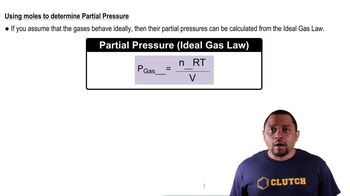
Partial Pressure

Partial pressure is the pressure exerted by a single gas in a mixture of gases. According to Dalton's Law of Partial Pressures, the total pressure of a gas mixture is the sum of the partial pressures of each individual gas. This concept is crucial for determining the behavior of gases when they are allowed to mix, as it helps in calculating the contribution of each gas to the overall pressure.
Video consigliato:
Percorso guidato
00:48
Partial Pressure Calculation

Ideal Gas Law

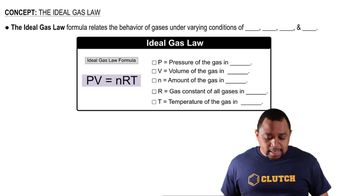
The Ideal Gas Law relates the pressure, volume, temperature, and number of moles of a gas through the equation PV = nRT. This law assumes that gases behave ideally, meaning they occupy no volume and have no intermolecular forces. Understanding this law is essential for solving problems involving gas mixtures, as it allows for the calculation of changes in pressure and volume when gases are combined.
Video consigliato:
Percorso guidato
01:15
Ideal Gas Law Formula

Gas Mixture Calculations

When dealing with gas mixtures, it is important to apply the principles of gas laws to determine the final conditions after mixing. This involves calculating the total volume and using the initial pressures and volumes of the individual gases to find their new partial pressures. These calculations are fundamental in predicting how gases will behave when they are allowed to mix in a closed system.
Video consigliato:
Percorso guidato
03:51
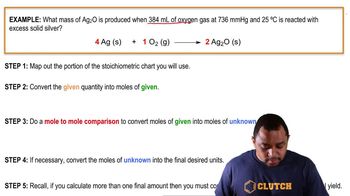
Gas Stoichiometry Calculation Example