Ch.11 - Liquids and Intermolecular Forces
Brown - Chemistry: The Central Science 15th Edition
Brown15th EditionChemistry: The Central ScienceISBN: 9780137542970Non è quello che usi tu?Cambia libro di testo
Capitolo 11, Problema 87

Suppose the vapor pressure of a substance is measured at two different temperatures.
a. By using the Clausius–Clapeyron equation (Equation 11.1), derive the following relationship between the vapor pressures, 𝑃1 and 𝑃2, and the absolute temperatures at which they were measured, 𝑇1 and 𝑇2:
ln𝑃1𝑃2=−Δ𝐻vap𝑅(1𝑇1−1𝑇2)
b. Gasoline is a mixture of hydrocarbons, a component of which is octane (CH3CH2CH2CH2CH2CH2CH2CH3). Octane has a vapor pressure of 13.95 torr at 25°C and a vapor pressure of 144.78 torr at 75°C. Use these data and the equation in part (a) to calculate the heat of vaporization of octane.
c. By using the equation in part (a) and the data given in part (b), calculate the normal boiling point of octane. Compare your answer to the one you obtained from Exercise 11.83.
d. Calculate the vapor pressure of octane at −30°C.

Guida verificata passo dopo passo
1
Identify the given values: vapor pressures P1 and P2 at temperatures T1 and T2 respectively. Convert temperatures from Celsius to Kelvin by adding 273.15 to each Celsius temperature.
Use the Clausius-Clapeyron equation in the form ln(P1/P2) = -ΔH_vap/R (1/T1 - 1/T2) to set up the equation with the known values of P1, P2, T1, and T2.
Rearrange the equation to solve for ΔH_vap, the heat of vaporization. ΔH_vap = -R * ln(P1/P2) / (1/T1 - 1/T2), where R is the gas constant (8.314 J/mol·K).
To find the normal boiling point of octane, set the vapor pressure equal to the standard atmospheric pressure (760 torr) and solve for the temperature using the Clausius-Clapeyron equation rearranged to solve for T2.
For calculating the vapor pressure at a new temperature (e.g., -30°C), convert this temperature to Kelvin and use the Clausius-Clapeyron equation with the known ΔH_vap to solve for the new vapor pressure.

Risposta video verificata per un problema simile:

Questa soluzione video è stata consigliata dai nostri tutor come utile per risolvere questo problema.
Durata del video:
3m

Concetti chiave

Ecco i concetti essenziali che devi comprendere per rispondere correttamente alla domanda.

Clausius–Clapeyron Equation

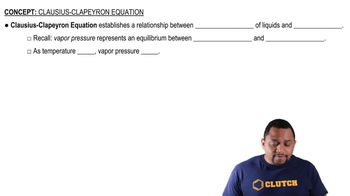
The Clausius–Clapeyron equation describes the relationship between vapor pressure and temperature for a substance. It is expressed as ln(P1/P2) = -ΔHvap/R(1/T1 - 1/T2), where P1 and P2 are vapor pressures at temperatures T1 and T2, ΔHvap is the heat of vaporization, and R is the ideal gas constant. This equation is crucial for understanding how changes in temperature affect the vapor pressure of a liquid.
Video consigliato:
Percorso guidato
00:59
Clausius-Clapeyron Equation

Heat of Vaporization (ΔHvap)

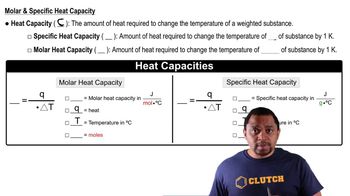
The heat of vaporization is the amount of energy required to convert a unit mass of a liquid into vapor at constant temperature and pressure. It is a critical property of substances, influencing their vapor pressures and boiling points. In the context of the Clausius–Clapeyron equation, ΔHvap is essential for calculating how much energy is needed for a substance to transition from liquid to gas, impacting its vapor pressure at different temperatures.
Video consigliato:

Vapor Pressure

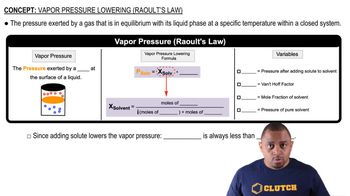
Vapor pressure is the pressure exerted by a vapor in equilibrium with its liquid or solid phase at a given temperature. It reflects the tendency of a substance to evaporate; higher vapor pressures indicate a greater propensity for evaporation. Understanding vapor pressure is vital for predicting the behavior of substances under varying temperature conditions, as seen in the calculations for octane in the given problem.
Video consigliato:
Percorso guidato
02:40
Raoult's Law and Vapor Pressure
Pratica correlata
Domanda del libro di testo

(b) A flask of water is connected to a vacuum pump. A few moments after the pump is turned on, the water begins to boil. After a few minutes, the water begins to freeze. Explain why these processes occur.

634
views

Domanda del libro di testo

Naphthalene (C10H8) is the main ingredient in traditional mothballs. Its normal melting point is 81 °C, its normal boiling point is 218 °C, and its triple point is 80 °C at 1000 Pa. Using the data, construct a phase diagram for naphthalene, labeling all the regions of your diagram.

2401
views
Domanda del libro di testo

In Table 11.3, we saw that the viscosity of a series of hydrocarbons increased with molecular weight, doubling from the six-carbon molecule to the ten-carbon molecule.

(a) The eight-carbon hydrocarbon, octane, has an isomer, isooctane. Would you predict that isooctane would have a larger or smaller viscosity than octane? Why?

530
views
Domanda del libro di testo

The following table gives the vapor pressure of hexafluorobenzene (C6F6) as a function of temperature: (a) By plotting these data in a suitable fashion, determine whether the Clausius–Clapeyron equation (Equation 11.1) is obeyed. If it is obeyed, use your plot to determine ∆Hvap for C6F6.

576
views
Domanda del libro di testo

(a) When you exercise vigorously, you sweat. How does this help your body cool?

436
views
Domanda del libro di testo

A particular liquid crystalline substance has the phase diagram shown in the figure. By analogy with the phase diagram for a nonliquid crystalline substance, identify the phase present in each area.

564
views