Describe how you would prepare each of the following aqueous solutions from water and solid KBr: b. 125 g of 0.180 m KBr.
Ch.13 - Properties of Solutions

Brown15th EditionChemistry: The Central ScienceISBN: 9780137542970Non è quello che usi tu?Cambia libro di testo
Capitolo 13, Problema 52a
Calculate the number of moles of solute present in each of the following solutions: (a) 255 mL of 1.50 M HNO3(aq),
Guida verificata passo dopo passo1
Convert the volume from milliliters to liters by dividing by 1000.
Use the formula for molarity: \( M = \frac{n}{V} \), where \( M \) is the molarity, \( n \) is the number of moles, and \( V \) is the volume in liters.
Rearrange the formula to solve for the number of moles: \( n = M \times V \).
Substitute the given values into the equation: \( n = 1.50 \, \text{M} \times 0.255 \, \text{L} \).
Calculate the number of moles by performing the multiplication.

Risposta video verificata per un problema simile:
Questa soluzione video è stata consigliata dai nostri tutor come utile per risolvere questo problema.
Durata del video:
51sConcetti chiave
Ecco i concetti essenziali che devi comprendere per rispondere correttamente alla domanda.
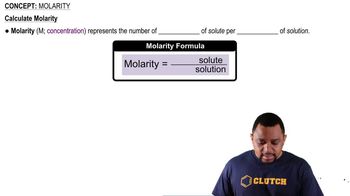
Molarity (M)
Molarity is a measure of concentration defined as the number of moles of solute per liter of solution. It is expressed in moles per liter (mol/L). Understanding molarity is essential for calculating the amount of solute in a given volume of solution, as it directly relates the volume of the solution to the number of moles present.
Video consigliato:
Percorso guidato
Molarity Concept
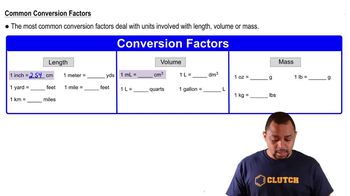
Volume Conversion
In chemistry, it is often necessary to convert between different units of volume. In this case, milliliters (mL) must be converted to liters (L) since molarity is defined in terms of liters. The conversion factor is 1 L = 1000 mL, which is crucial for accurately calculating the number of moles of solute in a solution.
Video consigliato:
Percorso guidato
Common Conversion Factors
Calculating Moles from Molarity
To find the number of moles of solute in a solution, the formula used is: moles = molarity × volume (in liters). This relationship allows for the direct calculation of moles when both the molarity and the volume of the solution are known, making it a fundamental concept in solution chemistry.
Video consigliato:
Percorso guidato
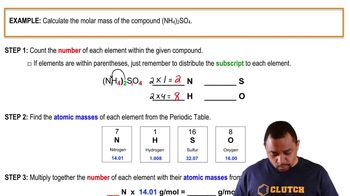
Molar Mass Calculation Example
Pratica correlata
Domanda del libro di testo
1
views
Domanda del libro di testo
Calculate the number of moles of solute present in each of the following aqueous solutions: (b) 86.4 g of 0.180 m KCl,
953
views
Domanda del libro di testo
Describe how you would prepare each of the following aqueous solutions from water and the solid solute: a. 1.50 L of 0.110 M (NH4)2SO4 solution;
Domanda del libro di testo
Calculate the number of moles of solute present in each of the following aqueous solutions: (c) 124.0 g of a solution that is 6.45% glucose (C6H12O6) by mass.
1016
views
Domanda del libro di testo
The density of toluene (C7H8) is 0.867 g/mL, and the density of thiophene (C4H4S) is 1.065 g/mL. A solution is made by dissolving 8.10 g of thiophene in 250.0 mL of toluene. (b) Calculate the molality of thiophene in the solution.
1763
views