Describe how you would prepare each of the following aqueous solutions from water and solid KBr: b. 125 g of 0.180 m KBr.
Ch.13 - Properties of Solutions

Brown15th EditionChemistry: The Central ScienceISBN: 9780137542970Non è quello che usi tu?Cambia libro di testo
Capitolo 13, Problema 54a
Describe how you would prepare each of the following aqueous solutions from water and the solid solute: a. 1.50 L of 0.110 M (NH4)2SO4 solution;
Guida verificata passo dopo passo1
Determine the molar mass of \((NH_4)_2SO_4\) by adding the atomic masses of all atoms in the formula.
Calculate the number of moles of \((NH_4)_2SO_4\) needed using the formula: \(\text{moles} = \text{molarity} \times \text{volume in liters}\).
Convert the moles of \((NH_4)_2SO_4\) to grams using the molar mass calculated in step 1.
Weigh the calculated mass of \((NH_4)_2SO_4\) using a balance.
Dissolve the weighed \((NH_4)_2SO_4\) in a volume of water less than 1.50 L, then dilute the solution to a final volume of 1.50 L in a volumetric flask.

Risposta video verificata per un problema simile:
Questa soluzione video è stata consigliata dai nostri tutor come utile per risolvere questo problema.
Durata del video:
1mConcetti chiave
Ecco i concetti essenziali che devi comprendere per rispondere correttamente alla domanda.
Molarity
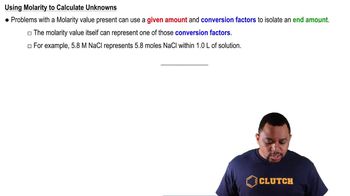
Molarity (M) is a measure of concentration defined as the number of moles of solute per liter of solution. It is crucial for preparing solutions, as it allows chemists to quantify how much solute is needed to achieve a desired concentration in a given volume of solvent. For example, a 0.110 M solution of (NH4)2SO4 means there are 0.110 moles of ammonium sulfate in every liter of solution.
Video consigliato:
Percorso guidato
Molarity
Dilution
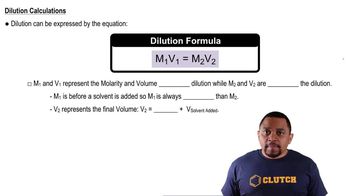
Dilution is the process of reducing the concentration of a solute in a solution, typically by adding more solvent. Understanding dilution is essential when preparing solutions, as it helps in calculating the amount of solute needed to achieve a specific molarity. The dilution formula, M1V1 = M2V2, relates the initial and final concentrations and volumes, guiding the preparation process.
Video consigliato:
Percorso guidato
Dilution Equation
Solubility
Solubility refers to the maximum amount of solute that can dissolve in a solvent at a given temperature and pressure. It is important to know the solubility of (NH4)2SO4 when preparing the solution to ensure that the solute can fully dissolve in the solvent without forming a precipitate. This concept helps in determining whether the desired concentration can be achieved with the available solute.
Video consigliato:
Percorso guidato
Solubility Rules
Pratica correlata
Domanda del libro di testo
1
views
Domanda del libro di testo
Calculate the number of moles of solute present in each of the following solutions: (a) 255 mL of 1.50 M HNO3(aq),
1422
views
Domanda del libro di testo
Brass is a substitutional alloy consisting of a solution of copper and zinc. A particular sample of red brass consisting of 80.0 % Cu and 20.0 % Zn by mass has a density of 8750 kg/m3. (a) What is the molality of Zn in the solid solution?
1945
views
Domanda del libro di testo
Commercial aqueous nitric acid has a density of 1.42 g/mL and is 16 M. Calculate the percent HNO3 by mass in the solution.
2791
views
1
comments
Domanda del libro di testo
Brass is a substitutional alloy consisting of a solution of copper and zinc. A particular sample of red brass consisting of 80.0 % Cu and 20.0 % Zn by mass has a density of 8750 kg/m3. (b) What is the molarity of Zn in the solution?
966
views