Ch.14 - Chemical Kinetics
Brown - Chemistry: The Central Science 15th Edition
Brown15th EditionChemistry: The Central ScienceISBN: 9780137542970Non è quello che usi tu?Cambia libro di testo
Capitolo 14, Problema 97

A first-order reaction A → B has the rate constant k = 3.2 * 10^-3 s^-1. If the initial concentration of A is 2.5 * 10^-2 M, what is the rate of the reaction at t = 660 s?

Guida verificata passo dopo passo
1
Step 1: Understand that for a first-order reaction, the rate of the reaction is given by the formula: rate = k[A], where k is the rate constant and [A] is the concentration of A at time t.
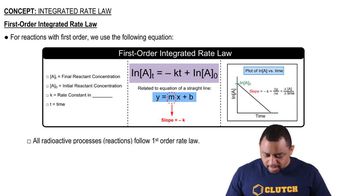
Step 2: Use the integrated rate law for a first-order reaction to find the concentration of A at time t. The integrated rate law is: ln([A]_t/[A]_0) = -kt, where [A]_t is the concentration at time t, [A]_0 is the initial concentration, and t is the time.
Step 3: Substitute the given values into the integrated rate law: ln([A]_t/2.5 \(\times\) 10^{-2}) = -(3.2 \(\times\) 10^{-3}) \(\times\) 660.
Step 4: Solve the equation from Step 3 to find [A]_t, the concentration of A at time t = 660 s.
Step 5: Substitute the value of [A]_t obtained in Step 4 into the rate equation from Step 1 to calculate the rate of the reaction at t = 660 s.

Concetti chiave

Ecco i concetti essenziali che devi comprendere per rispondere correttamente alla domanda.

First-Order Reactions

First-order reactions are chemical reactions where the rate is directly proportional to the concentration of one reactant. This means that as the concentration of the reactant decreases, the rate of the reaction also decreases. The rate law for a first-order reaction can be expressed as rate = k[A], where k is the rate constant and [A] is the concentration of the reactant.
Video consigliato:
Percorso guidato
02:29
First-Order Reactions

Rate Constant (k)

The rate constant (k) is a proportionality factor in the rate law that is specific to a given reaction at a specific temperature. It indicates how quickly a reaction proceeds; a larger k value signifies a faster reaction. For first-order reactions, the units of k are typically s^-1, reflecting the dependence of the reaction rate on the concentration of the reactant.
Video consigliato:
Percorso guidato
01:14
Equilibrium Constant K

Integrated Rate Law for First-Order Reactions

The integrated rate law for a first-order reaction relates the concentration of the reactant at any time (t) to its initial concentration and the rate constant. It is expressed as ln([A]0/[A]) = kt, where [A]0 is the initial concentration, [A] is the concentration at time t, and k is the rate constant. This equation allows for the calculation of concentration changes over time, which is essential for determining the rate of the reaction at a specific time.
Video consigliato:
Percorso guidato
02:29
First-Order Reactions
Pratica correlata
Domanda del libro di testo

The reaction 2 NO2 → 2 NO + O2 has the rate constant k = 0.63 M-1s-1. (a) Based on the units for k, is the reaction first or second order in NO2?

Domanda del libro di testo

Americium-241 is used in smoke detectors. It has a first-order rate constant for radioactive decay of k = 1.6 * 10-3 yr-1. By contrast, iodine-125, which is used to test for thyroid functioning, has a rate constant for radioactive decay of k = 0.011 day-1. (a) What are the half-lives of these two isotopes? (b) Which one decays at a faster rate?

1041
views
Domanda del libro di testo

Americium-241 is used in smoke detectors. It has a first-order rate constant for radioactive decay of k = 1.6 * 10-3 yr-1. By contrast, iodine-125, which is used to test for thyroid functioning, has a rate constant for radioactive decay of k = 0.011 day-1. (c) How much of a 1.00-mg sample of each isotope remains after three half-lives? (d) How much of a 1.00-mg sample of each isotope remains after 4 days?

1043
views
Domanda del libro di testo

Consider two reactions. Reaction (1) has a constant halflife, whereas reaction (2) has a half-life that gets longer as the reaction proceeds. What can you conclude about the rate laws of these reactions from these observations?

588
views
Domanda del libro di testo

The reaction 2 NO2 → 2 NO + O2 has the rate constant k = 0.63 M-1s-1.

(b) If the initial concentration of NO2 is 0.100 M, how would you determine how long it would take for the concentration to decrease to 0.025 M?

1326
views