
Ch.14 - Chemical Kinetics
Brown - Chemistry: The Central Science 15th Edition
Brown15th EditionChemistry: The Central ScienceISBN: 9780137542970Non è quello che usi tu?Cambia libro di testo
Capitolo 14, Problema 18c

(c) As a reaction proceeds, does the instantaneous reaction rate increase or decrease?

Guida verificata passo dopo passo
1
1. The instantaneous reaction rate refers to the rate of reaction at a particular moment in time. It is the rate at which reactants are consumed or products are formed at that specific instant.
2. As a reaction proceeds, the concentration of the reactants decreases because they are being used up to form products. This is a fundamental principle of chemical reactions.
3. The rate of a reaction is often proportional to the concentration of the reactants. This relationship is described by the rate law, which is an equation that relates the reaction rate to the concentrations of the reactants.
4. Therefore, as the reaction proceeds and the concentration of the reactants decreases, the instantaneous reaction rate also decreases.
5. In conclusion, the instantaneous reaction rate generally decreases as a reaction proceeds, unless the reaction is zero order, in which case the rate is constant and does not depend on the concentration of the reactants.

Risposta video verificata per un problema simile:

Questa soluzione video è stata consigliata dai nostri tutor come utile per risolvere questo problema.
Durata del video:
2m

Concetti chiave

Ecco i concetti essenziali che devi comprendere per rispondere correttamente alla domanda.

Reaction Rate

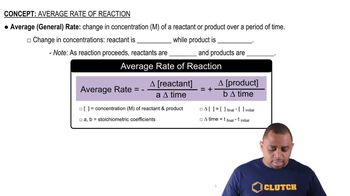
The reaction rate is a measure of how quickly reactants are converted into products in a chemical reaction. It is typically expressed as the change in concentration of a reactant or product per unit time. Understanding the factors that influence reaction rates, such as concentration, temperature, and catalysts, is essential for analyzing how these rates change over the course of a reaction.
Video consigliato:
Percorso guidato
02:03
Average Rate of Reaction

Instantaneous Rate

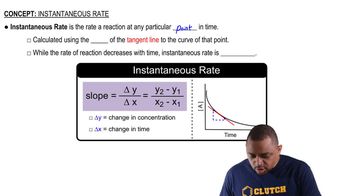
The instantaneous rate of a reaction refers to the rate at a specific moment in time, rather than over an interval. It can be determined by taking the slope of the tangent line to the concentration vs. time curve at that point. This concept is crucial for understanding how the rate of reaction evolves as reactants are consumed and products are formed.
Video consigliato:
Percorso guidato
01:30
Instantaneous Rate

Reaction Mechanism

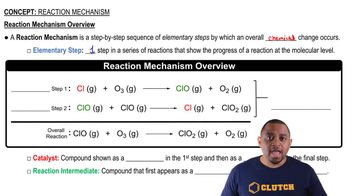
A reaction mechanism is a detailed description of the step-by-step process by which reactants are transformed into products. It includes the sequence of elementary steps, intermediates, and transition states involved. The mechanism can influence how the instantaneous reaction rate changes, as different steps may have varying rates and can be affected by factors like concentration and temperature.
Video consigliato:
Percorso guidato
03:06
Reaction Mechanism Overview
Pratica correlata
Domanda del libro di testo

Consider the following hypothetical aqueous reaction: A(aq) → B(aq). A flask is charged with 0.065 mol of A in a total volume of 100.0 mL. The following data are collected: Time (min) 0 10 20 30 40 Moles of A 0.065 0.051 0.042 0.036 0.031 (b) Calculate the average rate of disappearance of A for each 10-min interval in units of M>s.

1558
views
1
rank
Domanda del libro di testo

(b) Name three factors that can affect the rate of a chemical reaction.

587
views
Domanda del libro di testo

b. As the temperature increases, does the reaction rate usually increase or decrease?

1
views
Domanda del libro di testo

Consider the following hypothetical aqueous reaction: A(aq) → B(aq). A flask is charged with 0.065 mol of A in a total volume of 100.0 mL. The following data are collected: Time (min) 0 10 20 30 40 Moles of A 0.065 0.051 0.042 0.036 0.031 (a) Calculate the number of moles of B at each time in the table, assuming that there are no molecules of B at time zero and that A cleanly converts to B with no intermediates.

904
views
Domanda del libro di testo

(a) What are the units usually used to express the rates of reactions occurring in solution?

1033
views
Domanda del libro di testo

Consider the following hypothetical aqueous reaction: A(aq) → B(aq). A flask is charged with 0.065 mol of A in a total volume of 100.0 mL. The following data are collected: Time (min) 0 10 20 30 40 Moles of A 0.065 0.051 0.042 0.036 0.031 (c) Between t = 10 min and t = 30 min, what is the average rate of appearance of B in units of M/s? Assume that the volume of the solution is constant.

2
views