Ch.14 - Chemical Kinetics
Brown - Chemistry: The Central Science 15th Edition
Brown15th EditionChemistry: The Central ScienceISBN: 9780137542970Non è quello che usi tu?Cambia libro di testo
Capitolo 14, Problema 19b

Consider the following hypothetical aqueous reaction: A(aq) → B(aq). A flask is charged with 0.065 mol of A in a total volume of 100.0 mL. The following data are collected: Time (min) 0 10 20 30 40 Moles of A 0.065 0.051 0.042 0.036 0.031 (b) Calculate the average rate of disappearance of A for each 10-min interval in units of M>s.

Guida verificata passo dopo passo
1
insert step 1> Start by understanding that the average rate of disappearance of a reactant is calculated using the formula: \( \text{Rate} = -\frac{\Delta [A]}{\Delta t} \), where \( \Delta [A] \) is the change in concentration of A and \( \Delta t \) is the change in time.
insert step 2> Convert the moles of A to concentration in molarity (M) by dividing the moles by the volume of the solution in liters. Since the volume is 100.0 mL, convert it to liters by dividing by 1000, which gives 0.1 L.
insert step 3> Calculate the concentration of A at each time interval by dividing the moles of A by the volume in liters. For example, at time 0, the concentration is \( \frac{0.065 \text{ mol}}{0.1 \text{ L}} = 0.65 \text{ M} \). Repeat this for each time point.
insert step 4> For each 10-minute interval, calculate \( \Delta [A] \) by subtracting the concentration of A at the end of the interval from the concentration at the beginning of the interval.
insert step 5> Calculate the average rate of disappearance for each interval by dividing \( \Delta [A] \) by \( \Delta t \) (10 minutes converted to seconds, which is 600 seconds) and apply the negative sign to indicate disappearance.

Risposta video verificata per un problema simile:

Questa soluzione video è stata consigliata dai nostri tutor come utile per risolvere questo problema.
Durata del video:
11m

Concetti chiave

Ecco i concetti essenziali che devi comprendere per rispondere correttamente alla domanda.

Molarity and Concentration

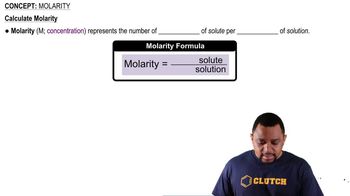
Molarity (M) is a measure of concentration defined as the number of moles of solute per liter of solution. In this context, understanding molarity is crucial for calculating the concentration of reactants in the reaction. Since the total volume of the solution is given, we can convert moles of A into molarity to analyze its change over time.
Video consigliato:
Percorso guidato
00:53
Molarity Concept

Rate of Reaction

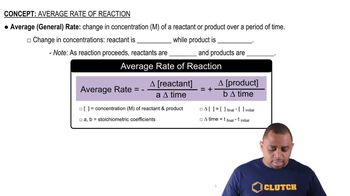
The rate of reaction refers to the change in concentration of a reactant or product per unit time. It is typically expressed in terms of molarity per second (M/s). In this question, calculating the average rate of disappearance of A involves determining how much the concentration of A decreases over specified time intervals, which is essential for understanding the kinetics of the reaction.
Video consigliato:
Percorso guidato
02:03
Average Rate of Reaction

Average Rate Calculation

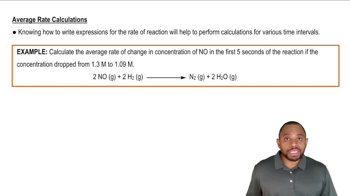
The average rate of a reaction over a time interval can be calculated using the formula: average rate = (change in concentration) / (change in time). For this problem, you will subtract the concentration of A at the end of each interval from its initial concentration and divide by the duration of the interval. This calculation provides insight into how quickly the reactant is consumed during the reaction.
Video consigliato:
Percorso guidato
02:42
Average Rate Calculation Example
Pratica correlata
Domanda del libro di testo

b. As the temperature increases, does the reaction rate usually increase or decrease?

1
views

Domanda del libro di testo

Consider the following hypothetical aqueous reaction: A(aq) → B(aq). A flask is charged with 0.065 mol of A in a total volume of 100.0 mL. The following data are collected: Time (min) 0 10 20 30 40 Moles of A 0.065 0.051 0.042 0.036 0.031 (a) Calculate the number of moles of B at each time in the table, assuming that there are no molecules of B at time zero and that A cleanly converts to B with no intermediates.

904
views
Domanda del libro di testo

(c) As a reaction proceeds, does the instantaneous reaction rate increase or decrease?

778
views
Domanda del libro di testo

Consider the following hypothetical aqueous reaction: A(aq) → B(aq). A flask is charged with 0.065 mol of A in a total volume of 100.0 mL. The following data are collected: Time (min) 0 10 20 30 40 Moles of A 0.065 0.051 0.042 0.036 0.031 (c) Between t = 10 min and t = 30 min, what is the average rate of appearance of B in units of M/s? Assume that the volume of the solution is constant.

2
views
Domanda del libro di testo

The isomerization of methyl isonitrile (CH3NC) to acetonitrile (CH3CN) was studied in the gas phase at 215°C, and the following data were obtained:

Time (s) [CH3NC] (M)

0 0.0165

2000 0.0110

5000 0.00591

8000 0.00314

12,000 0.00137

15,000 0.00074

(a) Calculate the average rate of reaction, in M/s, for the time interval between each measurement. (c) Which is greater, the average rate between t = 2000 and t = 12,000 s, or between t = 8000 and t = 15,000 s?

2
views
Domanda del libro di testo

A flask is charged with 0.100 mol of A and allowed to react to form B according to the hypothetical gas-phase reaction A1g2¡B1g2. The following data are collected: Time (s) 0 40 80 120 160 Moles of A 0.100 0.067 0.045 0.030 0.020 (c) Which of the following would be needed to calculate the rate in units of concentration per time: (i) the pressure of the gas at each time, (ii) the volume of the reaction flask, (iii) the temperature, or (iv) the molecular weight of A?

1064
views