
Ch.14 - Chemical Kinetics
Brown - Chemistry: The Central Science 15th Edition
Brown15th EditionChemistry: The Central ScienceISBN: 9780137542970Non è quello che usi tu?Cambia libro di testo
Capitolo 14, Problema 30d

Consider the following reaction: 2 NO1g2 + 2 H21g2¡N21g2 + 2 H2O1g2 (d) What is the reaction rate at 1000 K if [NO] is decreased to 0.010 M and 3H24 is increased to 0.030 M?

Guida verificata passo dopo passo
1
Identify the rate law for the reaction. Since the rate law is not provided, assume it is dependent on the concentrations of the reactants raised to their stoichiometric coefficients in the balanced equation. Thus, the rate law can be expressed as: Rate = k[NO]^2[H2]^2.
Substitute the given concentrations of the reactants into the rate law. Here, [NO] = 0.010 M and [H2] = 0.030 M. Plug these values into the rate law equation: Rate = k(0.010)^2(0.030)^2.
Simplify the expression by calculating the powers. Calculate (0.010)^2 and (0.030)^2.
Multiply the results of the powers with each other to get the final expression for the rate in terms of the rate constant k.
To find the numerical value of the rate, the rate constant k at 1000 K would be needed. This can typically be found in experimental data or calculated using the Arrhenius equation if the activation energy and frequency factor are known.

Risposta video verificata per un problema simile:

Questa soluzione video è stata consigliata dai nostri tutor come utile per risolvere questo problema.
Durata del video:
2m

Concetti chiave

Ecco i concetti essenziali che devi comprendere per rispondere correttamente alla domanda.

Reaction Rate

The reaction rate is a measure of how quickly reactants are converted into products in a chemical reaction. It is typically expressed in terms of the change in concentration of a reactant or product per unit time. Factors such as temperature, concentration, and the presence of catalysts can influence the reaction rate.
Video consigliato:
Percorso guidato
02:03
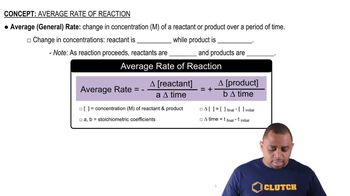
Average Rate of Reaction

Concentration and Its Effect

Concentration refers to the amount of a substance in a given volume of solution. In chemical reactions, changes in the concentration of reactants can significantly affect the reaction rate. According to the rate law, the rate of a reaction is often proportional to the concentration of the reactants raised to a power, which reflects their stoichiometric coefficients in the balanced equation.
Video consigliato:
Percorso guidato
02:31
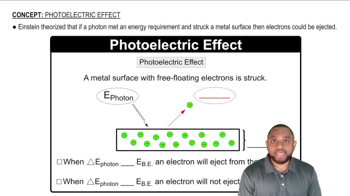
Photoelectric Effect

Temperature Dependence

Temperature plays a crucial role in chemical reactions, as it affects the kinetic energy of molecules. Higher temperatures generally increase the reaction rate by providing more energy for collisions between reactant molecules, leading to a greater frequency of successful reactions. The Arrhenius equation quantitatively describes this relationship, showing how the rate constant changes with temperature.
Video consigliato:
Percorso guidato
01:24
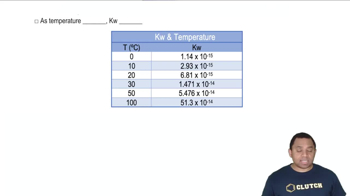
Kw Temperature Dependence
Pratica correlata
Domanda del libro di testo

The reaction between ethyl bromide (C2H5Br) and hydroxide ion in ethyl alcohol at 330 K, C2H5Br(alc) + OH-(alc) → C2H5OH(l) + Br-(alc), is first order each in ethyl bromide and hydroxide ion. When [C2H5Br] is 0.0477 M and [OH-] is 0.100 M, the rate of disappearance of ethyl bromide is 1.7×10⁻⁷ M/s. (b) What are the units of the rate constant?

Domanda del libro di testo

The decomposition reaction of N2O5 in carbon tetrachloride is 2 N2O5 → 4 NO2 + O2. The rate law is first order in N2O5. At 64°C the rate constant is 4.82 × 10⁻³ s-1. (c) What happens to the rate when the concentration of N2O5 is doubled to 0.0480 M? (d) What happens to the rate when the concentration of N2O5 is halved to 0.0120 M?

Domanda del libro di testo

The decomposition reaction of N2O5 in carbon tetrachloride is 2 N2O5 → 4 NO2 + O2. The rate law is first order in N2O5. At 64°C the rate constant is 4.82 × 10⁻³ s-1. (a) Write the rate law for the reaction.

3127
views
Domanda del libro di testo

The reaction between ethyl bromide (C2H5Br) and hydroxide ion in ethyl alcohol at 330 K, C2H5Br(alc) + OH-(alc) → C2H5OH(l) + Br-(alc), is first order each in ethyl bromide and hydroxide ion. When [C2H5Br] is 0.0477 M and [OH-] is 0.100 M, the rate of disappearance of ethyl bromide is 1.7×10⁻⁷ M/s. (a) What is the value of the rate constant?

412
views
Domanda del libro di testo

Consider the following reaction:

2 NO(g) + 2 H2(g) → N2(g) + 2 H2O(g)

(b) If the rate constant for this reaction at 1000 K is 6.0 × 10⁴ M-2 s-1, what is the reaction rate when [NO] = 0.035 M and [H2] = 0.015 M?

(c) What is the reaction rate at 1000 K when the concentration of NO is increased to 0.10 M, while the concentration of H2 is 0.010 M?