Ch.14 - Chemical Kinetics
Brown - Chemistry: The Central Science 15th Edition
Brown15th EditionChemistry: The Central ScienceISBN: 9780137542970Non è quello che usi tu?Cambia libro di testo
Capitolo 14, Problema 32b

The reaction between ethyl bromide (C2H5Br) and hydroxide ion in ethyl alcohol at 330 K, C2H5Br(alc) + OH-(alc) → C2H5OH(l) + Br-(alc), is first order each in ethyl bromide and hydroxide ion. When [C2H5Br] is 0.0477 M and [OH-] is 0.100 M, the rate of disappearance of ethyl bromide is 1.7×10⁻⁷ M/s. (b) What are the units of the rate constant?

Guida verificata passo dopo passo
1
Identify the rate law for the reaction. Since the reaction is first order in both ethyl bromide and hydroxide ion, the rate law can be expressed as: \( \text{Rate} = k [\text{C}_2\text{H}_5\text{Br}] [\text{OH}^-] \).
Understand that the rate constant \( k \) has units that depend on the overall order of the reaction. For a reaction that is first order in each reactant, the overall order is the sum of the orders, which is 2.
Recall that the units of rate are typically expressed in \( \text{M/s} \) (molarity per second).
To find the units of the rate constant \( k \), rearrange the rate law to solve for \( k \): \( k = \frac{\text{Rate}}{[\text{C}_2\text{H}_5\text{Br}] [\text{OH}^-]} \).
Substitute the units into the rearranged rate law: \( k = \frac{\text{M/s}}{\text{M} \times \text{M}} \). Simplify this expression to find the units of \( k \), which will be \( \text{M}^{-1}\text{s}^{-1} \).

Risposta video verificata per un problema simile:

Questa soluzione video è stata consigliata dai nostri tutor come utile per risolvere questo problema.
Durata del video:
3m

Concetti chiave

Ecco i concetti essenziali che devi comprendere per rispondere correttamente alla domanda.

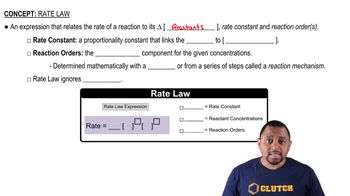
Rate Law

The rate law expresses the relationship between the rate of a chemical reaction and the concentration of its reactants. For a reaction that is first order in each reactant, the rate can be described by the equation: Rate = k[C2H5Br][OH-], where k is the rate constant. Understanding the rate law is essential for determining how changes in concentration affect the reaction rate.
Video consigliato:
Percorso guidato
01:52
Rate Law Fundamentals

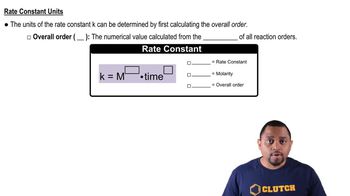
Units of the Rate Constant

The units of the rate constant (k) depend on the overall order of the reaction. For a reaction that is first order in both reactants, the overall order is two. The units of k can be derived from the rate equation, leading to units of M^-1 s^-1 for a second-order reaction. This understanding is crucial for calculating and interpreting the rate constant in the context of the given reaction.
Video consigliato:
Percorso guidato
00:45
Rate Constant Units

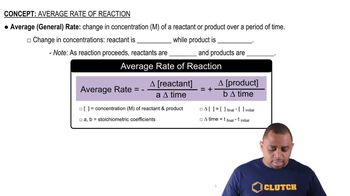
Concentration and Reaction Rate

The concentration of reactants directly influences the rate of a chemical reaction. In this case, the concentrations of ethyl bromide and hydroxide ion are given, and their values are used to calculate the rate of disappearance of ethyl bromide. Recognizing how concentration affects reaction kinetics is vital for understanding the dynamics of the reaction and for applying the rate law effectively.
Video consigliato:
Percorso guidato
02:03
Average Rate of Reaction
Pratica correlata
Domanda del libro di testo

Consider the following reaction: 2 NO1g2 + 2 H21g2¡N21g2 + 2 H2O1g2 (d) What is the reaction rate at 1000 K if [NO] is decreased to 0.010 M and 3H24 is increased to 0.030 M?

437
views

Domanda del libro di testo

The iodide ion reacts with hypochlorite ion (the active ingredient in chlorine bleaches) in the following way: OCl - + I - ¡OI - + Cl - . This rapid reaction gives the following rate data:

[OCl4-] (M) [I-] (M) Initial Rate (M,s)

1.5 * 10-3 1.5 * 10-3

1.36 * 10-4 3.0 * 10-3 1.5 * 10-3 2.72 * 10-4

1.5 * 10-3 3.0 * 10-3 2.72 * 10-4

(b) Calculate the rate constant with proper units.

386
views
Domanda del libro di testo

The iodide ion reacts with hypochlorite ion (the active ingredient in chlorine bleaches) in the following way: OCl- + I- → OI- + Cl- . This rapid reaction gives the following rate data:

[OCl4-] (M) [I-] (M) Initial Rate (M,s)

1.5 * 10-3 1.5 * 10-3

1.36 * 10-4 3.0 * 10-3 1.5 * 10-3 2.72 * 10-4

1.5 * 10-3 3.0 * 10-3 2.72 * 10-4

(a) Write the rate law for this reaction.

1867
views
Domanda del libro di testo

The reaction between ethyl bromide (C2H5Br) and hydroxide ion in ethyl alcohol at 330 K, C2H5Br(alc) + OH-(alc) → C2H5OH(l) + Br-(alc), is first order each in ethyl bromide and hydroxide ion. When [C2H5Br] is 0.0477 M and [OH-] is 0.100 M, the rate of disappearance of ethyl bromide is 1.7×10⁻⁷ M/s. (c) How would the rate of disappearance of ethyl bromide change if the solution were diluted by adding an equal volume of pure ethyl alcohol to the solution?

560
views
1
rank
Domanda del libro di testo

The reaction between ethyl bromide (C2H5Br) and hydroxide ion in ethyl alcohol at 330 K, C2H5Br(alc) + OH-(alc) → C2H5OH(l) + Br-(alc), is first order each in ethyl bromide and hydroxide ion. When [C2H5Br] is 0.0477 M and [OH-] is 0.100 M, the rate of disappearance of ethyl bromide is 1.7×10⁻⁷ M/s. (a) What is the value of the rate constant?

412
views