Indicate whether each of the following statements about the reaction quotient Q is true or false: (b) If 𝑄𝑐 < 𝐾𝑐, the reaction needs to proceed to the right to reach equilibrium.

Ch.15 - Chemical Equilibrium

Brown15th EditionChemistry: The Central ScienceISBN: 9780137542970Non è quello che usi tu?Cambia libro di testo
Capitolo 15, Problema 45
At 100 _x001F_C, Kc = 0.078 for the reaction SO2Cl2(g) ⇌ SO2(g) + Cl2(g). In an equilibrium mixture of the three gases, the concentrations of SO2Cl2 and SO2 are 0.108 M and 0.052 M, respectively. What is the partial pressure of Cl2 in the equilibrium mixture?
Guida verificata passo dopo passo1
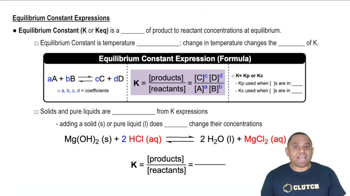
Identify the equilibrium expression for the reaction: SO2Cl2(g) ⇌ SO2(g) + Cl2(g). The equilibrium constant expression (Kc) is given by Kc = [SO2][Cl2]/[SO2Cl2].
Substitute the known values into the equilibrium expression. You have [SO2Cl2] = 0.108 M and [SO2] = 0.052 M. The equilibrium constant Kc is 0.078.
Rearrange the equilibrium expression to solve for the unknown concentration of Cl2. This gives [Cl2] = Kc * [SO2Cl2] / [SO2].
Substitute the known values into the rearranged equation to find the concentration of Cl2. This involves multiplying Kc by [SO2Cl2] and then dividing by [SO2].
The concentration of Cl2 obtained from the calculation is the same as its partial pressure in the equilibrium mixture, assuming ideal gas behavior.
Concetti chiave
Ecco i concetti essenziali che devi comprendere per rispondere correttamente alla domanda.
Equilibrium Constant (Kc)
The equilibrium constant (Kc) is a numerical value that expresses the ratio of the concentrations of products to reactants at equilibrium for a given reaction at a specific temperature. For the reaction SO2Cl2(g) ⇌ SO2(g) + Cl2(g), Kc = [SO2][Cl2]/[SO2Cl2]. A Kc value less than 1 indicates that at equilibrium, the concentration of reactants is greater than that of products.
Video consigliato:
Percorso guidato
Equilibrium Constant Expressions
Partial Pressure
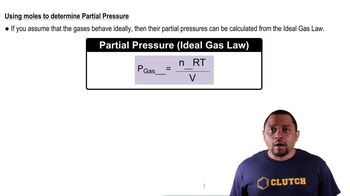
Partial pressure is the pressure exerted by a single component of a gas mixture. According to Dalton's Law, the total pressure of a gas mixture is the sum of the partial pressures of each individual gas. The partial pressure of a gas can be calculated using the ideal gas law, where P = (n/V)RT, or by using the concentration of the gas in the mixture and the total pressure.
Video consigliato:
Percorso guidato
Partial Pressure Calculation
Ideal Gas Law
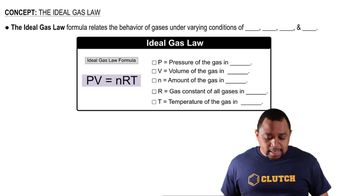
The ideal gas law is a fundamental equation in chemistry that relates the pressure, volume, temperature, and number of moles of an ideal gas. It is expressed as PV = nRT, where P is pressure, V is volume, n is the number of moles, R is the ideal gas constant, and T is temperature in Kelvin. This law allows for the calculation of gas properties under various conditions, including determining partial pressures in equilibrium systems.
Video consigliato:
Percorso guidato
Ideal Gas Law Formula
Pratica correlata
Domanda del libro di testo
At 900 K, the following reaction has 𝐾𝑝 = 0.345: 2 SO2(𝑔) + O2(𝑔) ⇌ 2 SO3(𝑔) In an equilibrium mixture the partial pressures of SO2 and O2 are 0.135 atm and 0.455 atm, respectively. What is the equilibrium partial pressure of SO3 in the mixture?
1046
views
Domanda del libro di testo
At 100°C, the equilibrium constant for the reaction COCl2(𝑔) ⇌ CO(𝑔) + Cl2(𝑔) has the value 𝐾𝑐 = 2.19×10⁻¹⁰. Are the following mixtures of COCl2, CO, and Cl2 at 100°C at equilibrium? If not, indicate the direction that the reaction must proceed to achieve equilibrium.
(a) [COCl2] = 2.00×10⁻³ M, [CO] = 3.3×10⁻⁶ M, [Cl2] = 6.62×10⁻⁶ M
(b) [COCl2] = 4.50×10⁻² M, [CO] = 1.1×10⁻⁷ M, [Cl2] = 2.25×10⁻⁶ M
(c) [COCl2] = 0.0100 M, [CO] = [Cl2] = 1.48×10⁻⁶ M
736
views