
At 80°C, 𝐾𝑐 = 1.87×10⁻³ for the reaction PH3BCl3(𝑠) ⇌ PH3(𝑔) + BCl3(𝑔) (a) Calculate the equilibrium concentrations of PH3 and BCl3 if a solid sample of PH3BCl3 is placed in a closed vessel at 80°C and decomposes until equilibrium is reached. (b) If the flask has a volume of 0.250 L, what is the minimum mass of PH3BCl3(𝑠) that must be added to the flask to achieve equilibrium?
Ch.15 - Chemical Equilibrium

Brown15th EditionChemistry: The Central ScienceISBN: 9780137542970Non è quello che usi tu?Cambia libro di testo
Capitolo 15, Problema 52a
At 80°C, 𝐾𝑐 = 1.87×10⁻³ for the reaction PH3BCl3(𝑠) ⇌ PH3(𝑔) + BCl3(𝑔) (a) Calculate the equilibrium concentrations of PH3 and BCl3 if a solid sample of PH3BCl3 is placed in a closed vessel at 80°C and decomposes until equilibrium is reached.
Guida verificata passo dopo passo1
Write the balanced chemical equation for the reaction: PH3BCl3(s) ⇌ PH3(g) + BCl3(g).
Set up an ICE (Initial, Change, Equilibrium) table. Since PH3BCl3 is a solid, its concentration does not appear in the expression for Kc. Assume initial concentrations of PH3 and BCl3 to be 0 M.
Let x be the change in concentration of PH3 and BCl3 as PH3BCl3 decomposes. At equilibrium, the concentrations of PH3 and BCl3 will both be x M.
Write the expression for the equilibrium constant, Kc, in terms of x: Kc = [PH3][BCl3]. Substitute the equilibrium concentrations into this expression to get Kc = x^2.
Solve the equation Kc = x^2 for x to find the equilibrium concentrations of PH3 and BCl3. Use the given value of Kc = 1.87×10⁻³ to find the value of x.

Risposta video verificata per un problema simile:
Questa soluzione video è stata consigliata dai nostri tutor come utile per risolvere questo problema.
Durata del video:
1mConcetti chiave
Ecco i concetti essenziali che devi comprendere per rispondere correttamente alla domanda.
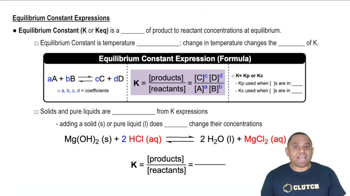
Equilibrium Constant (Kc)
The equilibrium constant (Kc) is a numerical value that expresses the ratio of the concentrations of products to reactants at equilibrium for a given reaction at a specific temperature. For the reaction PH₃BCl₃(s) ⇌ PH₃(g) + BCl₃(g), Kc = [PH₃][BCl₃] / [PH₃BCl₃]. Since solids do not appear in the expression, Kc only involves the gaseous products.
Video consigliato:
Percorso guidato
Equilibrium Constant Expressions
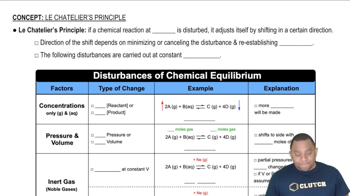
Le Chatelier's Principle
Le Chatelier's Principle states that if a dynamic equilibrium is disturbed by changing the conditions, the system will adjust to counteract the change and restore a new equilibrium. In this case, if PH₃BCl₃ decomposes, the system will shift to produce more PH₃ and BCl₃ until the concentrations reach a state that satisfies the equilibrium constant.
Video consigliato:
Percorso guidato
Le Chatelier's Principle
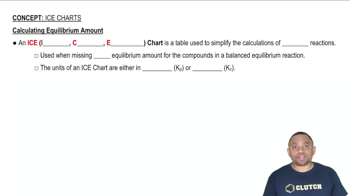
ICE Table (Initial, Change, Equilibrium)
An ICE table is a tool used to organize the initial concentrations, the changes in concentrations, and the equilibrium concentrations of reactants and products in a chemical reaction. For this reaction, the initial concentration of PH₃BCl₃ is known, and as it decomposes, the changes in concentrations of PH₃ and BCl₃ can be calculated to find their equilibrium concentrations using the Kc value.
Video consigliato:
Percorso guidato
ICE Charts and Equilibrium Amount
Pratica correlata
Domanda del libro di testo
302
views
1
rank
Domanda del libro di testo
At 218°C, 𝐾𝑐 = 1.2×10⁻⁴ for the equilibrium NH4SH(𝑠) ⇌ NH3(𝑔) + H2S(𝑔) (a) Calculate the equilibrium concentrations of NH3 and H2S if a sample of solid NH4SH is placed in a closed vessel at 218°C and decomposes until equilibrium is reached.
Domanda del libro di testo
At 25°C, the reaction CaCrO4(𝑠) ⇌ Ca2+(𝑎𝑞) + CrO42−(𝑎𝑞) has an equilibrium constant 𝐾𝑐 = 7.1×10⁻⁴. What are the equilibrium concentrations of Ca2+ and CrO42− in a saturated solution of CaCrO4?
398
views
