
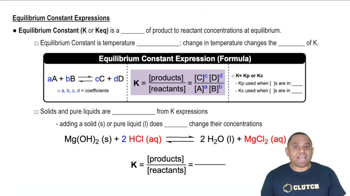
At 80°C, 𝐾𝑐 = 1.87×10⁻³ for the reaction PH3BCl3(𝑠) ⇌ PH3(𝑔) + BCl3(𝑔) (a) Calculate the equilibrium concentrations of PH3 and BCl3 if a solid sample of PH3BCl3 is placed in a closed vessel at 80°C and decomposes until equilibrium is reached.

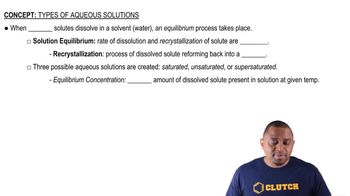
At 25°C, the reaction CaCrO4(𝑠) ⇌ Ca2+(𝑎𝑞) + CrO42−(𝑎𝑞) has an equilibrium constant 𝐾𝑐 = 7.1×10⁻⁴. What are the equilibrium concentrations of Ca2+ and CrO42− in a saturated solution of CaCrO4?
Guida verificata passo dopo passo
Risposta video verificata per un problema simile:
Concetti chiave
Equilibrium Constant (Kc)
Saturated Solution
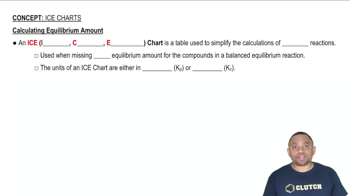
ICE Table (Initial, Change, Equilibrium)
At 80°C, 𝐾𝑐 = 1.87×10⁻³ for the reaction PH3BCl3(𝑠) ⇌ PH3(𝑔) + BCl3(𝑔) (a) Calculate the equilibrium concentrations of PH3 and BCl3 if a solid sample of PH3BCl3 is placed in a closed vessel at 80°C and decomposes until equilibrium is reached. (b) If the flask has a volume of 0.250 L, what is the minimum mass of PH3BCl3(𝑠) that must be added to the flask to achieve equilibrium?
At 218°C, 𝐾𝑐 = 1.2×10⁻⁴ for the equilibrium NH4SH(𝑠) ⇌ NH3(𝑔) + H2S(𝑔) (a) Calculate the equilibrium concentrations of NH3 and H2S if a sample of solid NH4SH is placed in a closed vessel at 218°C and decomposes until equilibrium is reached.
At 2000°C, the equilibrium constant for the reaction 2 NO(𝑔) ⇌ N2(𝑔) + O2(𝑔) is 𝐾𝑐 = 2.4×10³. If the initial concentration of NO is 0.175 M, what are the equilibrium concentrations of NO, N2, and O2?
