
Ch.15 - Chemical Equilibrium
Brown - Chemistry: The Central Science 15th Edition
Brown15th EditionChemistry: The Central ScienceISBN: 9780137542970Non è quello che usi tu?Cambia libro di testo
Capitolo 15, Problema 49

At 800 K, the equilibrium constant for the reaction I2(g) ⇌ 2 I(g) is Kc = 3.1 * 10^-5. If an equilibrium mixture in a 10.0-L vessel contains 2.67 * 10^-2 g of I(g), how many grams of I2 are in the mixture?

Guida verificata passo dopo passo
1
Convert the mass of I(g) to moles using its molar mass. The molar mass of iodine (I) is approximately 126.90 g/mol.
Calculate the concentration of I(g) in moles per liter by dividing the moles of I(g) by the volume of the vessel in liters.
Use the equilibrium constant expression for the reaction: Kc = [I]^2 / [I2]. Rearrange this expression to solve for the concentration of I2.
Substitute the known values into the rearranged equilibrium expression to find the concentration of I2 in moles per liter.
Convert the concentration of I2 to grams using its molar mass (I2 has a molar mass of approximately 253.80 g/mol) and the volume of the vessel.

Concetti chiave

Ecco i concetti essenziali che devi comprendere per rispondere correttamente alla domanda.

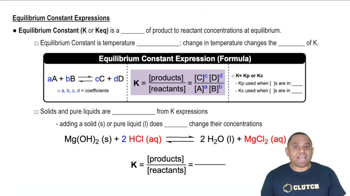
Equilibrium Constant (Kc)

The equilibrium constant (Kc) is a numerical value that expresses the ratio of the concentrations of products to reactants at equilibrium for a given reaction at a specific temperature. For the reaction I2(g) ⇌ 2 I(g), Kc = [I]^2 / [I2]. A small Kc value, like 3.1 * 10^-5, indicates that at equilibrium, the concentration of reactants (I2) is much greater than that of products (I).
Video consigliato:
Percorso guidato
03:20
Equilibrium Constant Expressions

Molar Mass and Conversion

To determine the amount of I2 in grams, it is essential to convert the mass of I(g) into moles using its molar mass. The molar mass of iodine (I) is approximately 126.9 g/mol. This conversion allows for the calculation of the concentration of I(g) in the equilibrium expression, which is necessary for finding the concentration of I2 using the equilibrium constant.
Video consigliato:
Percorso guidato
02:11
Molar Mass Concept

Stoichiometry in Equilibrium

Stoichiometry involves the quantitative relationships between reactants and products in a chemical reaction. In this case, the stoichiometric coefficients indicate that for every mole of I2 produced, two moles of I(g) are formed. This relationship is crucial for calculating the amount of I2 present in the equilibrium mixture based on the amount of I(g) and the equilibrium constant.
Video consigliato:
Percorso guidato
01:16
Stoichiometry Concept