Ch.15 - Chemical Equilibrium
Brown - Chemistry: The Central Science 15th Edition
Brown15th EditionChemistry: The Central ScienceISBN: 9780137542970Non è quello che usi tu?Cambia libro di testo
Capitolo 15, Problema 65a

Consider the following equilibrium between oxides of nitrogen 3 NO(g) ⇌ NO2(g) + N2O(g) (a) At constant temperature, would a change in the volume of the container affect the fraction of products in the equilibrium mixture?

Guida verificata passo dopo passo
1
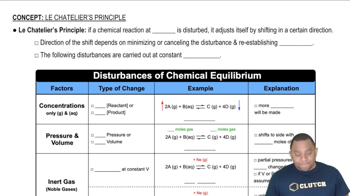
Understand the concept of Le Chatelier's Principle, which states that if a dynamic equilibrium is disturbed by changing the conditions, the position of equilibrium shifts to counteract the change.
Identify the change in conditions: In this case, the volume of the container is changed.
Recognize that changing the volume of a gaseous equilibrium system affects the pressure. A decrease in volume increases pressure, while an increase in volume decreases pressure.
Count the moles of gas on each side of the equilibrium: On the left side, there are 3 moles of NO(g), and on the right side, there are 1 mole of NO2(g) and 1 mole of N2O(g), totaling 2 moles.
Apply Le Chatelier's Principle: If the volume decreases (pressure increases), the equilibrium will shift towards the side with fewer moles of gas to reduce pressure, which is the right side (products). Conversely, if the volume increases (pressure decreases), the equilibrium will shift towards the left side (reactants).

Risposta video verificata per un problema simile:

Questa soluzione video è stata consigliata dai nostri tutor come utile per risolvere questo problema.
Durata del video:
2m

Concetti chiave

Ecco i concetti essenziali che devi comprendere per rispondere correttamente alla domanda.

Le Chatelier's Principle

Le Chatelier's Principle states that if a dynamic equilibrium is disturbed by changing the conditions, the system will adjust to counteract the change and restore a new equilibrium. In the context of gas reactions, changes in volume can affect the concentrations of reactants and products, prompting the system to shift in a direction that minimizes the effect of the change.
Video consigliato:
Percorso guidato
07:32
Le Chatelier's Principle

Equilibrium Constant (K)

The equilibrium constant (K) is a numerical value that expresses the ratio of the concentrations of products to reactants at equilibrium for a given reaction at a specific temperature. For the reaction 3 NO(g) ⇌ NO<sub>2</sub>(g) + N<sub>2</sub>O(g), the equilibrium constant can help predict how changes in volume or pressure will affect the concentrations of the gases involved.
Video consigliato:
Percorso guidato
01:14
Equilibrium Constant K

Gas Laws and Volume Changes

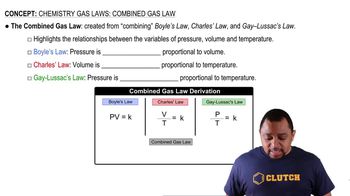
Gas laws describe the behavior of gases under various conditions of pressure, volume, and temperature. According to Boyle's Law, decreasing the volume of a gas increases its pressure, which can shift the equilibrium position of a reaction involving gases. Understanding how volume changes impact gas behavior is crucial for predicting the outcome of equilibrium reactions.
Video consigliato:
Percorso guidato
01:43
Combined Gas Law