Ch.15 - Chemical Equilibrium
Brown - Chemistry: The Central Science 15th Edition
Brown15th EditionChemistry: The Central ScienceISBN: 9780137542970Non è quello che usi tu?Cambia libro di testo
Capitolo 15, Problema 10a

The diagram shown here represents the equilibrium state for the reaction A2(𝑔) + 2B(𝑔) ⇌ 2AB(𝑔). (a) Assuming the volume is 2 L, calculate the equilibrium constant 𝐾𝑐 for the reaction.

Guida verificata passo dopo passo
1
Step 1: Identify the equilibrium concentrations of the reactants and products from the diagram. The number of molecules of each species in the diagram represents the number of moles of that species. Divide the number of moles by the volume (2 L) to get the molar concentration.
Step 2: Write the expression for the equilibrium constant, Kc, for the reaction. For the reaction A2(g) + 2B(g) ⇌ 2AB(g), the equilibrium constant expression is Kc = [AB]^2 / ([A2][B]^2).
Step 3: Substitute the equilibrium concentrations from Step 1 into the equilibrium constant expression from Step 2. Remember that the concentrations should be in moles per liter (M).
Step 4: Perform the calculations as indicated in the equilibrium constant expression. Remember to square the concentration of AB and B as indicated in the equilibrium constant expression.
Step 5: The result of these calculations is the equilibrium constant, Kc, for the reaction. This value indicates the extent to which the reaction proceeds to the right (towards the products) at equilibrium.

Risposta video verificata per un problema simile:

Questa soluzione video è stata consigliata dai nostri tutor come utile per risolvere questo problema.
Durata del video:
3m

Concetti chiave

Ecco i concetti essenziali che devi comprendere per rispondere correttamente alla domanda.

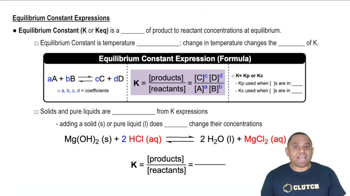
Equilibrium Constant (Kc)

The equilibrium constant, Kc, is a numerical value that expresses the ratio of the concentrations of products to reactants at equilibrium for a given reaction at a specific temperature. It is calculated using the formula Kc = [products]^[coefficients] / [reactants]^[coefficients]. A Kc value greater than 1 indicates that products are favored at equilibrium, while a value less than 1 suggests that reactants are favored.
Video consigliato:
Percorso guidato
03:20
Equilibrium Constant Expressions

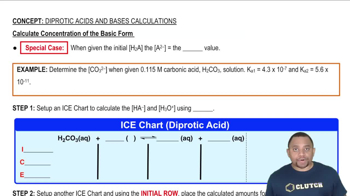
Concentration

Concentration refers to the amount of a substance (solute) present in a given volume of solution. It is typically expressed in moles per liter (Molarity, M). In equilibrium calculations, the concentrations of the reactants and products at equilibrium are essential for determining the value of Kc, as they directly influence the ratio used in the equilibrium expression.
Video consigliato:
Percorso guidato
07:35
Calculate Concentration of the Basic Form

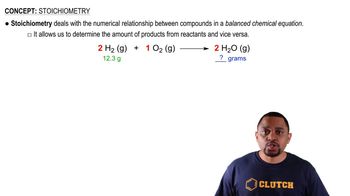
Stoichiometry

Stoichiometry is the branch of chemistry that deals with the quantitative relationships between the reactants and products in a chemical reaction. It involves using the coefficients from the balanced chemical equation to relate the amounts of substances consumed and produced. In the context of equilibrium, stoichiometry is crucial for determining the concentrations of reactants and products based on their initial amounts and the changes that occur as the system reaches equilibrium.
Video consigliato:
Percorso guidato
01:16
Stoichiometry Concept
Pratica correlata
Domanda del libro di testo

The equilibrium constant for the dissociation of molecular iodine, I2(g) ⇌ 2 I(g), at 800 K is Kc = 3.1 × 10⁻⁵. (a) Which species predominates at equilibrium I2 or I?

Domanda del libro di testo

The reaction A2 + B2 ⇌ 2 AB has an equilibrium constant Kc = 1.5. The following diagrams represent reaction mixtures containing A2 molecules (red), B2 molecules (blue), and AB molecules. (a) Which reaction mixture is at equilibrium?

1344
views
Domanda del libro di testo

The equilibrium constant for the dissociation of molecular iodine, I2(g) ⇌ 2 I(g), at 800 K is Kc = 3.1×10⁻⁵. (b) Assuming both forward and reverse reactions are elementary reactions, which reaction has the larger rate constant, the forward or the reverse reaction?

1209
views
Domanda del libro di testo

When lead(IV) oxide is heated above 300°C, it decomposes according to the reaction, 2 PbO2(𝑠)⇌2PbO(𝑠)+O2(𝑔). Consider the two sealed vessels of PbO2 shown here. If both vessels are heated to 400°C and allowed to come to equilibrium, which of the following statements is or are true? c. The partial pressure of O2(𝑔) will be the same in vessels A and B. [Section 15.4]

Domanda del libro di testo

When lead(IV) oxide is heated above 300°C, it decomposes according to the reaction, 2 PbO2(𝑠)⇌2PbO(𝑠)+O2(𝑔). Consider the two sealed vessels of PbO2 shown here. If both vessels are heated to 400°C and allowed to come to equilibrium, which of the following statements is or are true?

b. The solid left at the bottom of each vessel will be a mixture of PbO2(𝑠) and PbO(𝑠).

Domanda del libro di testo

Suppose that the gas-phase reactions A → B and B → A are both elementary reactions with rate constants of 4.7×10⁻³ s−1 and 5.8×10⁻¹ s−1, respectively. (a) What is the value of the equilibrium constant for the equilibrium A(g) ⇌ B(g)? (b) Which is greater at equilibrium, the partial pressure of A or the partial pressure of B?

469
views