
Ch.15 - Chemical Equilibrium
Brown - Chemistry: The Central Science 15th Edition
Brown15th EditionChemistry: The Central ScienceISBN: 9780137542970Non è quello che usi tu?Cambia libro di testo
Capitolo 15, Problema 8b

When lead(IV) oxide is heated above 300°C, it decomposes according to the reaction, 2 PbO2(𝑠)⇌2PbO(𝑠)+O2(𝑔). Consider the two sealed vessels of PbO2 shown here. If both vessels are heated to 400°C and allowed to come to equilibrium, which of the following statements is or are true?
b. The solid left at the bottom of each vessel will be a mixture of PbO2(𝑠) and PbO(𝑠).

Guida verificata passo dopo passo
1
Identify the chemical reaction involved: The decomposition of lead(IV) oxide (PbO2) into lead(II) oxide (PbO) and oxygen gas (O2) is given by the equation: 2 PbO2(s) ⇌ 2 PbO(s) + O2(g).
Understand the concept of equilibrium: At equilibrium, the rate of the forward reaction (decomposition of PbO2) equals the rate of the reverse reaction (formation of PbO2 from PbO and O2).
Consider the conditions: Both vessels are heated to 400°C, which is above the decomposition temperature of PbO2, allowing the reaction to proceed until equilibrium is reached.
Analyze the composition of the solid phase: At equilibrium, the solid phase will consist of both reactant (PbO2) and product (PbO) because the reaction does not go to completion and some PbO2 will remain.
Conclude about the statement: Since the reaction reaches equilibrium and both PbO2 and PbO are present in the solid phase, the statement that the solid left at the bottom of each vessel will be a mixture of PbO2(s) and PbO(s) is true.

Risposta video verificata per un problema simile:

Questa soluzione video è stata consigliata dai nostri tutor come utile per risolvere questo problema.
Durata del video:
57s

Concetti chiave

Ecco i concetti essenziali che devi comprendere per rispondere correttamente alla domanda.

Chemical Equilibrium

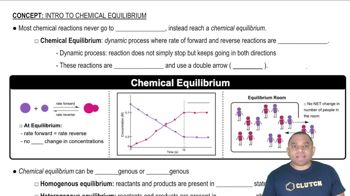
Chemical equilibrium occurs when the rates of the forward and reverse reactions are equal, resulting in constant concentrations of reactants and products. In the context of the given reaction, as PbO2 decomposes into PbO and O2, the system will reach a point where the formation of PbO and O2 balances with the decomposition of PbO back into PbO2, leading to a dynamic but stable state.
Video consigliato:
Percorso guidato
04:21
Chemical Equilibrium Concepts

Le Chatelier's Principle

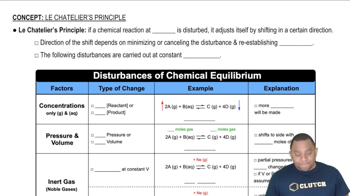
Le Chatelier's Principle states that if a system at equilibrium is subjected to a change in concentration, temperature, or pressure, the system will adjust to counteract that change and restore a new equilibrium. In this case, heating the PbO2 will shift the equilibrium position to favor the formation of PbO and O2, indicating that the solid left will contain both PbO2 and PbO.
Video consigliato:
Percorso guidato
07:32
Le Chatelier's Principle

Decomposition Reactions

Decomposition reactions involve the breakdown of a compound into simpler substances, often requiring heat or energy. The reaction of PbO2 decomposing into PbO and O2 is a classic example, where the application of heat above 300°C initiates the breakdown, leading to the formation of different solid products and gaseous oxygen, which is crucial for understanding the composition of the solids in the vessels.
Video consigliato:
Percorso guidato
01:30
Alcohol Reactions: Dehydration Reactions
Pratica correlata
Domanda del libro di testo

Ethene (C2H4) reacts with halogens (X2) by the following reaction:

C2H4(𝑔) + X2(𝑔) ⇌ C2H4X2(𝑔)

The following figures represent the concentrations at equilibrium at the same temperature when X2 is Cl2 (green), Br2 (brown), and I2 (purple). List the equilibria from smallest to largest equilibrium constant. [Section 15.3]

491
views
Domanda del libro di testo

The diagram shown here represents the equilibrium state for the reaction A2(𝑔) + 2B(𝑔) ⇌ 2AB(𝑔). (a) Assuming the volume is 2 L, calculate the equilibrium constant 𝐾𝑐 for the reaction.

663
views
Domanda del libro di testo

The reaction A2 + B2 ⇌ 2 AB has an equilibrium constant Kc = 1.5. The following diagrams represent reaction mixtures containing A2 molecules (red), B2 molecules (blue), and AB molecules. (a) Which reaction mixture is at equilibrium?

1344
views
Domanda del libro di testo

When lead(IV) oxide is heated above 300°C, it decomposes according to the reaction, 2 PbO2(𝑠) ⇌ 2PbO(𝑠) + O2(𝑔). Consider the two sealed vessels of PbO2 shown here. If both vessels are heated to 400°C and allowed to come to equilibrium, which of the following statements is or are true? a. There will be less PbO2 remaining in vessel A than in vessel B.

Domanda del libro di testo

When lead(IV) oxide is heated above 300°C, it decomposes according to the reaction, 2 PbO2(𝑠)⇌2PbO(𝑠)+O2(𝑔). Consider the two sealed vessels of PbO2 shown here. If both vessels are heated to 400°C and allowed to come to equilibrium, which of the following statements is or are true? c. The partial pressure of O2(𝑔) will be the same in vessels A and B. [Section 15.4]

Domanda del libro di testo

The following diagram represents a reaction shown going to completion. Each molecule in the diagram represents 0.1 mol, and the volume of the box is 1.0 L. (d) Assuming that all of the molecules are in the gas phase, calculate n, the change in the number of gas molecules that accompanies the reaction. [Section 15.2]

600
views