
Ch.15 - Chemical Equilibrium
Brown - Chemistry: The Central Science 15th Edition
Brown15th EditionChemistry: The Central ScienceISBN: 9780137542970Non è quello che usi tu?Cambia libro di testo
Capitolo 15, Problema 8a

When lead(IV) oxide is heated above 300°C, it decomposes according to the reaction, 2 PbO2(𝑠) ⇌ 2PbO(𝑠) + O2(𝑔). Consider the two sealed vessels of PbO2 shown here. If both vessels are heated to 400°C and allowed to come to equilibrium, which of the following statements is or are true? a. There will be less PbO2 remaining in vessel A than in vessel B.

Guida verificata passo dopo passo
1
Step 1: Understand the chemical reaction. The decomposition of lead(IV) oxide (PbO2) into lead(II) oxide (PbO) and oxygen gas (O2) is given by the equation: 2 PbO2(s) ⇌ 2 PbO(s) + O2(g). This is an equilibrium reaction, meaning it can proceed in both forward and reverse directions.
Step 2: Consider the conditions of the reaction. Both vessels are heated to 400°C, which is above the decomposition temperature of PbO2. At this temperature, the reaction will proceed towards equilibrium.
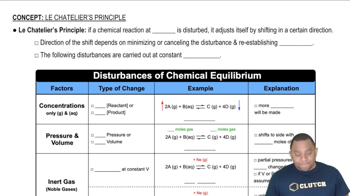
Step 3: Apply Le Chatelier's Principle. This principle states that if a dynamic equilibrium is disturbed by changing the conditions, the position of equilibrium shifts to counteract the change. In this case, heating the vessels increases the temperature, which favors the endothermic direction (the decomposition of PbO2).
Step 4: Analyze the effect of vessel conditions. If the vessels have different initial amounts of PbO2 or different volumes, the extent of decomposition might differ. However, at equilibrium, the ratio of products to reactants will be the same in both vessels, assuming they are identical in all other respects.
Step 5: Evaluate the statement. To determine if there will be less PbO2 in vessel A than in vessel B, consider any differences in initial conditions (such as initial amounts of PbO2 or vessel volume) that could affect the equilibrium position. Without specific differences, the statement cannot be conclusively evaluated.

Risposta video verificata per un problema simile:

Questa soluzione video è stata consigliata dai nostri tutor come utile per risolvere questo problema.
Durata del video:
57s

Concetti chiave

Ecco i concetti essenziali che devi comprendere per rispondere correttamente alla domanda.

Le Chatelier's Principle

Le Chatelier's Principle states that if a dynamic equilibrium is disturbed by changing the conditions, the position of equilibrium shifts to counteract the change. In the context of the decomposition of lead(IV) oxide, increasing the temperature will favor the endothermic reaction, shifting the equilibrium to the right and producing more PbO and O2, thus reducing the amount of PbO2.
Video consigliato:
Percorso guidato
07:32
Le Chatelier's Principle

Equilibrium Constant (K)

The equilibrium constant (K) quantifies the ratio of the concentrations of products to reactants at equilibrium for a given reaction at a specific temperature. For the decomposition of PbO2, the value of K will change with temperature, influencing the amounts of PbO2, PbO, and O2 present in the sealed vessels once equilibrium is reached after heating.
Video consigliato:
Percorso guidato
01:14
Equilibrium Constant K

Endothermic vs. Exothermic Reactions

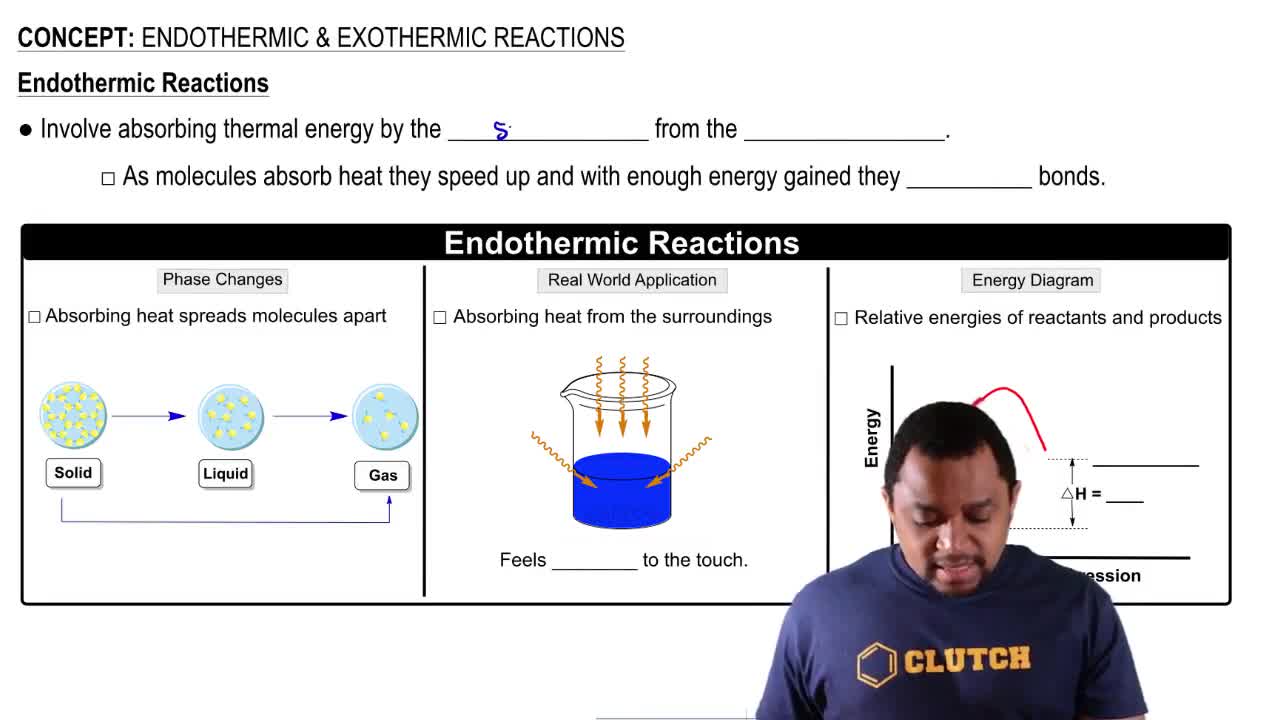
Reactions can be classified as endothermic or exothermic based on heat absorption or release. The decomposition of PbO2 into PbO and O2 is endothermic, meaning it absorbs heat. When the temperature is increased, the reaction shifts to produce more products, which is crucial for understanding the changes in the amounts of PbO2 in the two vessels after heating.
Video consigliato:
Percorso guidato
02:30
Endothermic & Exothermic Reactions
Pratica correlata
Domanda del libro di testo

Ethene (C2H4) reacts with halogens (X2) by the following reaction:

C2H4(𝑔) + X2(𝑔) ⇌ C2H4X2(𝑔)

The following figures represent the concentrations at equilibrium at the same temperature when X2 is Cl2 (green), Br2 (brown), and I2 (purple). List the equilibria from smallest to largest equilibrium constant. [Section 15.3]

491
views
Domanda del libro di testo

The reaction A2 + B2 ⇌ 2 AB has an equilibrium constant Kc = 1.5. The following diagrams represent reaction mixtures containing A2 molecules (red), B2 molecules (blue), and AB molecules. (a) Which reaction mixture is at equilibrium?

1344
views
Domanda del libro di testo

When lead(IV) oxide is heated above 300°C, it decomposes according to the reaction, 2 PbO2(𝑠)⇌2PbO(𝑠)+O2(𝑔). Consider the two sealed vessels of PbO2 shown here. If both vessels are heated to 400°C and allowed to come to equilibrium, which of the following statements is or are true? c. The partial pressure of O2(𝑔) will be the same in vessels A and B. [Section 15.4]

Domanda del libro di testo

The following diagram represents a reaction shown going to completion. Each molecule in the diagram represents 0.1 mol, and the volume of the box is 1.0 L. (d) Assuming that all of the molecules are in the gas phase, calculate n, the change in the number of gas molecules that accompanies the reaction. [Section 15.2]

600
views
Domanda del libro di testo

When lead(IV) oxide is heated above 300°C, it decomposes according to the reaction, 2 PbO2(𝑠)⇌2PbO(𝑠)+O2(𝑔). Consider the two sealed vessels of PbO2 shown here. If both vessels are heated to 400°C and allowed to come to equilibrium, which of the following statements is or are true?

b. The solid left at the bottom of each vessel will be a mixture of PbO2(𝑠) and PbO(𝑠).