
Citric acid, which is present in citrus fruits, is a triprotic acid (Table 16.3). (a) Calculate the pH of a 0.040 M solution of citric acid. (b) Did you have to make any approximations or assumptions in completing your calculations? (c) Is the concentration of citrate ion 1C6H5O7 3-2 equal to, less than, or greater than the H+ ion concentration?
Ch.16 - Acid-Base Equilibria

Brown15th EditionChemistry: The Central ScienceISBN: 9780137542970Non è quello che usi tu?Cambia libro di testo
Capitolo 16, Problema 71a
Consider the base hydroxylamine, NH2OH. (a) What is the conjugate acid of hydroxylamine?
Guida verificata passo dopo passo1
Identify the base in the problem: hydroxylamine, which is NH2OH.
Recall the concept of a conjugate acid: it is formed when a base gains a proton (H+).
Add a proton (H+) to the base NH2OH. This involves adding an H+ ion to the nitrogen atom, which is the site of protonation.
Write the chemical formula of the conjugate acid: NH3OH+.
Verify the charge balance: The original base NH2OH is neutral, and after gaining a proton, the conjugate acid NH3OH+ has a positive charge.

Risposta video verificata per un problema simile:
Questa soluzione video è stata consigliata dai nostri tutor come utile per risolvere questo problema.
Durata del video:
1mConcetti chiave
Ecco i concetti essenziali che devi comprendere per rispondere correttamente alla domanda.
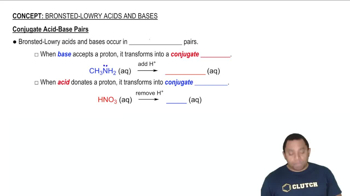
Conjugate Acid-Base Pairs
In acid-base chemistry, a conjugate acid is formed when a base accepts a proton (H+). This concept is essential for understanding how substances interact in chemical reactions, particularly in Brønsted-Lowry acid-base theory, which defines acids as proton donors and bases as proton acceptors.
Video consigliato:
Percorso guidato
Conjugate Acid-Base Pairs
Protonation
Protonation is the process by which a molecule gains a proton, resulting in the formation of a conjugate acid. For hydroxylamine (NH2OH), protonation occurs at the nitrogen atom, which has a lone pair of electrons that can bond with a proton, leading to the formation of its conjugate acid.
Video consigliato:
Percorso guidato
Neutron-to-Proton Plot
Hydroxylamine Structure
Hydroxylamine (NH2OH) consists of an amine group (NH2) and a hydroxyl group (OH). Understanding its molecular structure is crucial for predicting its behavior in acid-base reactions, including how it can act as a base and what its conjugate acid will be when it accepts a proton.
Video consigliato:
Percorso guidato
Resonance Structures
Pratica correlata
Domanda del libro di testo
1670
views
Domanda del libro di testo
Calculate the percent ionization of propionic acid (C2H5COOH) in solutions of each of the following concentrations (Ka is given in Appendix D): (a) 0.250 M (b) 0.0800 M (c) 0.0200 M
630
views
Domanda del libro di testo
The hypochlorite ion, ClO-, acts as a weak base. (a) Is ClO- a stronger or weaker base than hydroxylamine?
2024
views
Domanda del libro di testo
The hypochlorite ion, ClO-, acts as a weak base. (b) When ClO- acts as a base, which atom, Cl or O, acts as the proton acceptor? (c) Can you use formal charges to rationalize your answer to part (b)?
775
views
