Write the chemical equation and the Kb expression for the reaction of each of the following bases with water: (a) propylamine, C3H7NH2
Ch.16 - Acid-Base Equilibria

Brown15th EditionChemistry: The Central ScienceISBN: 9780137542970Non è quello che usi tu?Cambia libro di testo
Capitolo 16, Problema 72c
The hypochlorite ion, ClO-, acts as a weak base. (b) When ClO- acts as a base, which atom, Cl or O, acts as the proton acceptor? (c) Can you use formal charges to rationalize your answer to part (b)?
Guida verificata passo dopo passo1
insert step 1> Identify the role of the hypochlorite ion (ClO-) as a base, which means it will accept a proton (H+).
insert step 2> Consider the structure of the hypochlorite ion: Cl is bonded to O, and O has a lone pair of electrons.
insert step 3> Determine which atom, Cl or O, is more likely to accept a proton. Oxygen is more electronegative than chlorine and has lone pairs, making it a better candidate for proton acceptance.
insert step 4> Use formal charges to rationalize: In ClO-, the formal charge on O is typically -1, while Cl is 0. The negative charge on O indicates a higher electron density, making it more likely to attract and accept a proton.
insert step 5> Conclude that the oxygen atom in ClO- acts as the proton acceptor due to its higher electronegativity and negative formal charge.

Risposta video verificata per un problema simile:
Questa soluzione video è stata consigliata dai nostri tutor come utile per risolvere questo problema.
Durata del video:
1mConcetti chiave
Ecco i concetti essenziali che devi comprendere per rispondere correttamente alla domanda.
Acid-Base Theory
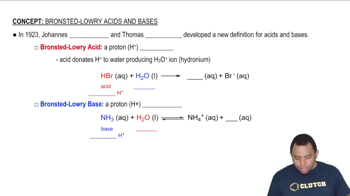
Acid-base theory explains the behavior of substances in terms of proton transfer. According to the Brønsted-Lowry definition, an acid is a proton donor, while a base is a proton acceptor. In the case of the hypochlorite ion (ClO-), understanding its role as a weak base is crucial for determining which atom accepts the proton during a reaction.
Video consigliato:
Percorso guidato
Bronsted-Lowry Acid-Base Theory
Proton Acceptor
In the context of acid-base reactions, the proton acceptor is the species that gains a hydrogen ion (H+). For the hypochlorite ion, the oxygen atom is typically the site of protonation due to its higher electronegativity compared to chlorine. This property allows oxygen to stabilize the positive charge that results from accepting a proton, making it the more likely proton acceptor.
Video consigliato:
Percorso guidato
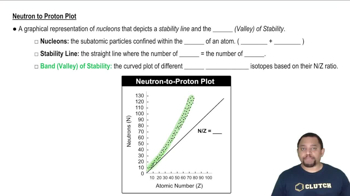
Neutron-to-Proton Plot
Formal Charge
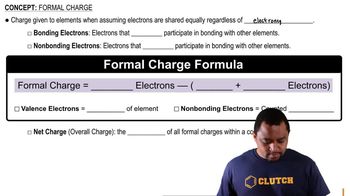
Formal charge is a theoretical concept used to determine the distribution of electrons in a molecule. It is calculated by comparing the number of valence electrons in an atom to the number of electrons it owns in a Lewis structure. In the case of ClO-, analyzing formal charges can help rationalize which atom (Cl or O) is more stable after protonation, thus supporting the identification of the proton acceptor.
Video consigliato:
Percorso guidato
Formal Charge
Pratica correlata
Domanda del libro di testo
752
views
Domanda del libro di testo
Citric acid, which is present in citrus fruits, is a triprotic acid (Table 16.3). (a) Calculate the pH of a 0.040 M solution of citric acid. (b) Did you have to make any approximations or assumptions in completing your calculations? (c) Is the concentration of citrate ion 1C6H5O7 3-2 equal to, less than, or greater than the H+ ion concentration?
1670
views
Domanda del libro di testo
Consider the base hydroxylamine, NH2OH. (a) What is the conjugate acid of hydroxylamine?
1199
views
Domanda del libro di testo
The hypochlorite ion, ClO-, acts as a weak base. (a) Is ClO- a stronger or weaker base than hydroxylamine?
2024
views
Domanda del libro di testo
Write the chemical equation and the Kb expression for the reaction of each of the following bases with water: (c) benzoate ion, C6H5CO2-
512
views