Ch.17 - Additional Aspects of Aqueous Equilibria
Brown - Chemistry: The Central Science 15th Edition
Brown15th EditionChemistry: The Central ScienceISBN: 9780137542970Non è quello che usi tu?Cambia libro di testo
Capitolo 17, Problema 16

Use information from Appendix D to calculate the pH of: (a) a solution that is 0.250 M in sodium formate (HCOONa) and 0.100 M in formic acid (HCOOH); (b) a solution that is 0.510 M in pyridine (C5H5N) and 0.450 M in pyridinium chloride (C5H5NHCl); (c) a solution that is made by combining 55 mL of 0.050 M hydrofluoric acid with 125 mL of 0.10 M sodium fluoride.

Guida verificata passo dopo passo
1
Step 1: Identify the type of solution for each part of the problem. For (a) and (b), these are buffer solutions, and for (c), it involves mixing two solutions to form a buffer.
Step 2: For part (a), use the Henderson-Hasselbalch equation: \( \text{pH} = \text{pKa} + \log \left( \frac{[\text{A}^-]}{[\text{HA}]} \right) \). Identify \( \text{pKa} \) for formic acid from Appendix D, and use the concentrations of sodium formate and formic acid.
Step 3: For part (b), again use the Henderson-Hasselbalch equation. Identify \( \text{pKa} \) for pyridinium ion from Appendix D, and use the concentrations of pyridine and pyridinium chloride.
Step 4: For part (c), calculate the moles of hydrofluoric acid and sodium fluoride using their concentrations and volumes. Then, find the total volume of the solution after mixing.
Step 5: Use the Henderson-Hasselbalch equation for part (c) with the calculated concentrations of fluoride ion and hydrofluoric acid in the final solution. Identify \( \text{pKa} \) for hydrofluoric acid from Appendix D.

Concetti chiave

Ecco i concetti essenziali che devi comprendere per rispondere correttamente alla domanda.

Buffer Solutions

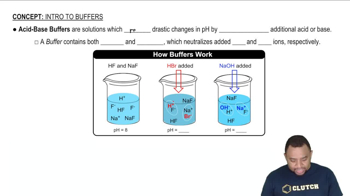
Buffer solutions are mixtures of a weak acid and its conjugate base or a weak base and its conjugate acid. They resist changes in pH when small amounts of acid or base are added. In the given question, sodium formate and formic acid form a buffer system, as do pyridine and pyridinium chloride, allowing for the calculation of pH using the Henderson-Hasselbalch equation.
Video consigliato:
Percorso guidato
03:02
Buffer Solutions

Henderson-Hasselbalch Equation

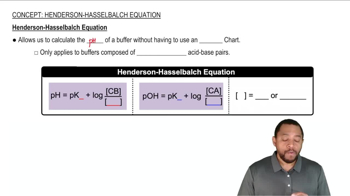
The Henderson-Hasselbalch equation is a mathematical formula used to calculate the pH of buffer solutions. It is expressed as pH = pKa + log([A-]/[HA]), where pKa is the negative logarithm of the acid dissociation constant, [A-] is the concentration of the conjugate base, and [HA] is the concentration of the weak acid. This equation is essential for determining the pH in the scenarios presented in the question.
Video consigliato:
Percorso guidato
02:40
Henderson-Hasselbalch Equation

Acid-Base Equilibria

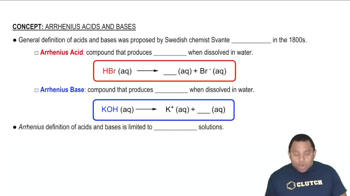
Acid-base equilibria involve the balance between acids and bases in a solution, which can be described by their dissociation constants (Ka for acids and Kb for bases). Understanding these equilibria is crucial for calculating pH, especially when mixing solutions of weak acids and their salts, as seen in the hydrofluoric acid and sodium fluoride combination in the question.
Video consigliato:
Percorso guidato
02:00
Arrhenius Acids and Bases