
Ch.17 - Additional Aspects of Aqueous Equilibria
Brown - Chemistry: The Central Science 15th Edition
Brown15th EditionChemistry: The Central ScienceISBN: 9780137542970Non è quello che usi tu?Cambia libro di testo
Capitolo 17, Problema 32a

You have to prepare a pH = 5.00 buffer, and you have the following 0.10 M solutions available: HCOOH, HCOONa, CH3COOH, CH3COONa, HCN, and NaCN. Which solutions would you use?

Guida verificata passo dopo passo
1
insert step 1> Identify the pKa values of the acids available: HCOOH, CH3COOH, and HCN.
insert step 2> Compare the pKa values to the desired pH of the buffer, which is 5.00.
insert step 3> Choose the acid whose pKa is closest to the desired pH, as this will provide the most effective buffer.
insert step 4> Select the corresponding salt of the chosen acid to pair with it, forming the buffer system.
insert step 5> Use the Henderson-Hasselbalch equation to verify that the chosen acid and its conjugate base can achieve the desired pH.

Risposta video verificata per un problema simile:

Questa soluzione video è stata consigliata dai nostri tutor come utile per risolvere questo problema.
Durata del video:
4m

Concetti chiave

Ecco i concetti essenziali che devi comprendere per rispondere correttamente alla domanda.

Buffer Solutions

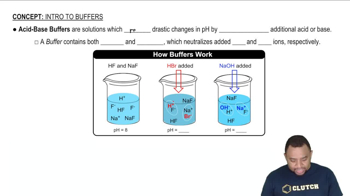
Buffer solutions are mixtures that resist changes in pH when small amounts of acid or base are added. They typically consist of a weak acid and its conjugate base or a weak base and its conjugate acid. In this case, a buffer at pH 5.00 can be created using a weak acid and its salt, which helps maintain the desired pH level.
Video consigliato:
Percorso guidato
03:02
Buffer Solutions

Henderson-Hasselbalch Equation

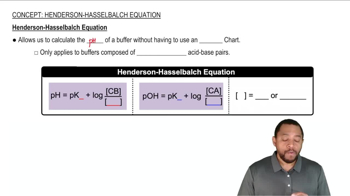
The Henderson-Hasselbalch equation relates the pH of a buffer solution to the concentration of the acid and its conjugate base. It is expressed as pH = pKa + log([A-]/[HA]), where pKa is the negative logarithm of the acid dissociation constant. This equation is essential for determining the appropriate ratio of acid to base needed to achieve a specific pH.
Video consigliato:
Percorso guidato
02:40
Henderson-Hasselbalch Equation

pKa Values

The pKa value is a measure of the strength of an acid in solution, indicating the pH at which half of the acid is dissociated. For effective buffer preparation, it is important to choose a weak acid with a pKa close to the desired pH. In this scenario, knowing the pKa values of the available acids (HCOOH, CH3COOH, HCN) will help identify which acid-base pair can effectively create a buffer at pH 5.00.
Video consigliato:
Percorso guidato
01:56
Gas Constant Values