
Ch.18 - Chemistry of the Environment
Brown - Chemistry: The Central Science 15th Edition
Brown15th EditionChemistry: The Central ScienceISBN: 9780137542970Non è quello che usi tu?Cambia libro di testo
Capitolo 18, Problema 1b

At 273 K and 1 atm pressure, 1 mol of an ideal gas occupies 22.4 L. (Section 10.4) (b) Looking at Figure 18.1, we see that the temperature is lower at 85 km altitude than at 50 km. Does this mean that one mole of an ideal gas would occupy less volume at 85 km than at 50 km? Explain.

Guida verificata passo dopo passo
1
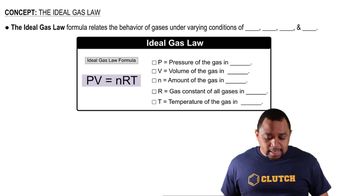
Identify the relationship between temperature, pressure, and volume for an ideal gas using the Ideal Gas Law: \( PV = nRT \).
Recognize that at a constant pressure, the volume of a gas is directly proportional to its temperature (Charles's Law): \( V \propto T \).
Understand that if the temperature decreases, the volume of the gas will also decrease, assuming pressure remains constant.
Consider the information given: the temperature is lower at 85 km altitude than at 50 km altitude.
Conclude that, under the assumption of constant pressure, one mole of an ideal gas would occupy less volume at 85 km than at 50 km due to the lower temperature.

Risposta video verificata per un problema simile:

Questa soluzione video è stata consigliata dai nostri tutor come utile per risolvere questo problema.

Concetti chiave

Ecco i concetti essenziali che devi comprendere per rispondere correttamente alla domanda.

Ideal Gas Law

The Ideal Gas Law, represented as PV=nRT, describes the relationship between pressure (P), volume (V), temperature (T), and the number of moles (n) of an ideal gas. It states that for a given amount of gas at a constant pressure, the volume is directly proportional to the temperature. This law is fundamental in understanding how changes in temperature and pressure affect the volume of a gas.
Video consigliato:
Percorso guidato
01:15
Ideal Gas Law Formula

Effect of Temperature on Gas Volume

According to the Ideal Gas Law, as temperature decreases, the volume of an ideal gas also decreases if pressure remains constant. This is because lower temperatures result in lower kinetic energy of gas molecules, leading to a reduction in the space they occupy. Therefore, at higher altitudes where temperatures are lower, one mole of an ideal gas would occupy less volume compared to lower altitudes.
Video consigliato:
Percorso guidato
02:35
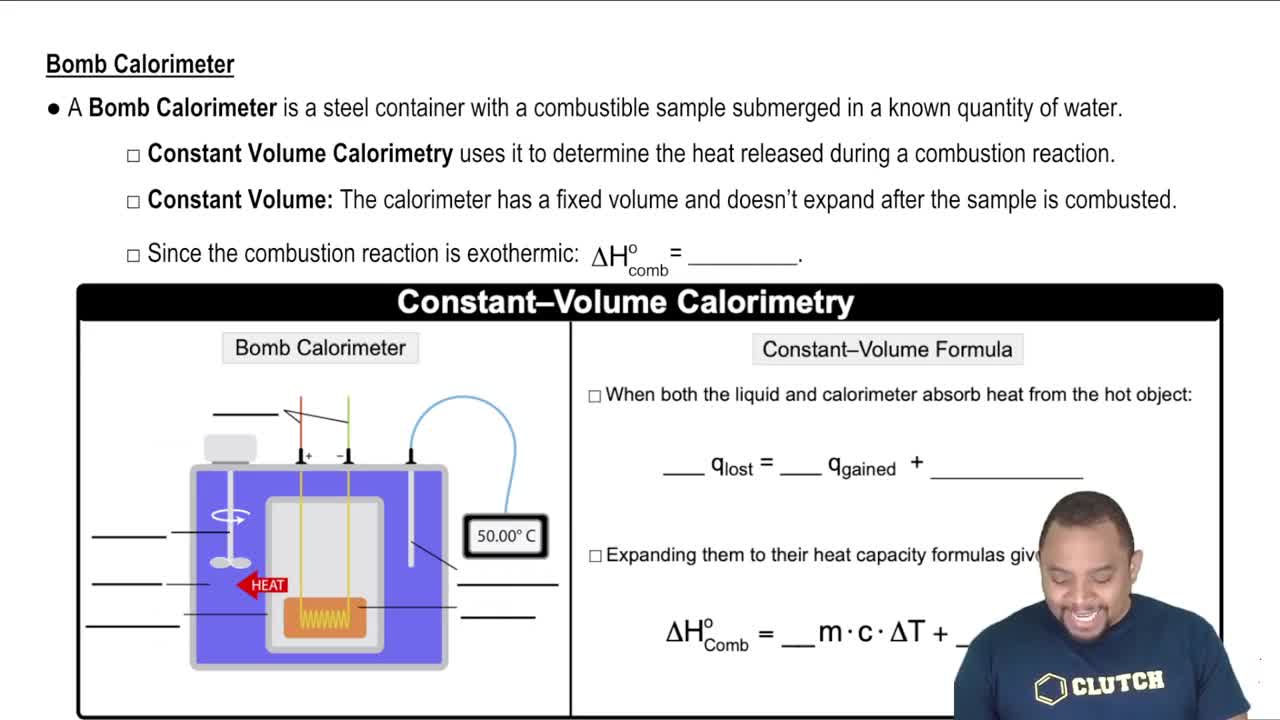
Constant-Volume Calorimetry

Altitude and Atmospheric Pressure

As altitude increases, atmospheric pressure decreases. This reduction in pressure can influence the behavior of gases, but in the context of the question, the primary factor is the temperature difference at varying altitudes. At 85 km, the lower temperature contributes more significantly to the volume change of the gas than the decrease in pressure, leading to a smaller volume for the gas at that altitude.
Video consigliato:
Percorso guidato
02:09
Total Pressure Example