Ch.19 - Chemical Thermodynamics
Brown - Chemistry: The Central Science 15th Edition
Brown15th EditionChemistry: The Central ScienceISBN: 9780137542970Non è quello che usi tu?Cambia libro di testo
Capitolo 19, Problema 53a

(a) For a process that occurs at constant temperature, does the change in Gibbs free energy depend on changes in the enthalpy and entropy of the system?

Guida verificata passo dopo passo
1
Identify the Gibbs free energy equation: \( \Delta G = \Delta H - T \Delta S \).
Recognize that \( \Delta G \) represents the change in Gibbs free energy, \( \Delta H \) is the change in enthalpy, \( T \) is the temperature in Kelvin, and \( \Delta S \) is the change in entropy.
Understand that at constant temperature, \( T \) remains unchanged, so the equation simplifies to show that \( \Delta G \) depends on \( \Delta H \) and \(\Delta\) S \).
Consider how changes in \( \Delta H \) and \( \Delta S \) affect \( \Delta G \): an increase in \( \Delta H \) increases \( \Delta G \), while an increase in \( \Delta S \) decreases \( \Delta G \) (since \( T \Delta S \) is subtracted).
Conclude that at constant temperature, the change in Gibbs free energy is indeed dependent on the changes in enthalpy and entropy of the system.

Risposta video verificata per un problema simile:

Questa soluzione video è stata consigliata dai nostri tutor come utile per risolvere questo problema.
Durata del video:
1m

Concetti chiave

Ecco i concetti essenziali che devi comprendere per rispondere correttamente alla domanda.

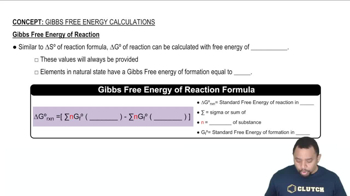
Gibbs Free Energy

Gibbs free energy (G) is a thermodynamic potential that measures the maximum reversible work obtainable from a system at constant temperature and pressure. It is defined by the equation G = H - TS, where H is enthalpy, T is temperature, and S is entropy. The change in Gibbs free energy (ΔG) indicates the spontaneity of a process: if ΔG is negative, the process is spontaneous, while a positive ΔG indicates non-spontaneity.
Video consigliato:
Percorso guidato
01:51
Gibbs Free Energy of Reactions

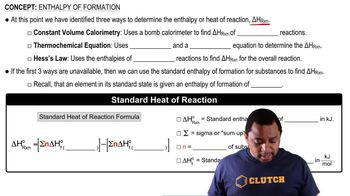
Enthalpy

Enthalpy (H) is a thermodynamic quantity that represents the total heat content of a system. It accounts for the internal energy of the system plus the product of its pressure and volume (H = U + PV). Changes in enthalpy (ΔH) during a process can indicate whether the process absorbs heat (endothermic, ΔH > 0) or releases heat (exothermic, ΔH < 0), which is crucial for understanding energy changes in chemical reactions.
Video consigliato:
Percorso guidato
02:34
Enthalpy of Formation

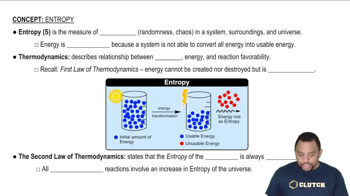
Entropy

Entropy (S) is a measure of the disorder or randomness in a system. It quantifies the number of ways a system can be arranged, with higher entropy indicating greater disorder. In thermodynamics, changes in entropy (ΔS) are important for predicting the direction of spontaneous processes. According to the second law of thermodynamics, the total entropy of an isolated system can never decrease over time, which plays a key role in determining the feasibility of reactions.
Video consigliato:
Percorso guidato
02:46
Entropy in Thermodynamics