Ch.19 - Chemical Thermodynamics
Brown - Chemistry: The Central Science 15th Edition
Brown15th EditionChemistry: The Central ScienceISBN: 9780137542970Non è quello che usi tu?Cambia libro di testo
Capitolo 19, Problema 53b

(b) For a certain process that occurs at constant T and P, the value of ΔG is positive. Is the process spontaneous?

Guida verificata passo dopo passo
1
Understand the concept of Gibbs Free Energy (ΔG): Gibbs Free Energy is a thermodynamic potential that can be used to predict the spontaneity of a process at constant temperature and pressure.
Recall the spontaneity criterion: A process is spontaneous if the change in Gibbs Free Energy (ΔG) is negative. If ΔG is positive, the process is non-spontaneous under the given conditions.
Analyze the given condition: The problem states that ΔG is positive for the process occurring at constant temperature and pressure.
Apply the spontaneity criterion to the given condition: Since ΔG is positive, according to the criterion, the process is not spontaneous.
Conclude based on the analysis: The process is non-spontaneous at constant temperature and pressure because the value of ΔG is positive.

Risposta video verificata per un problema simile:

Questa soluzione video è stata consigliata dai nostri tutor come utile per risolvere questo problema.
Durata del video:
1m

Concetti chiave

Ecco i concetti essenziali che devi comprendere per rispondere correttamente alla domanda.

Gibbs Free Energy (ΔG)

Gibbs Free Energy (ΔG) is a thermodynamic potential that measures the maximum reversible work obtainable from a thermodynamic system at constant temperature and pressure. A negative ΔG indicates that a process can occur spontaneously, while a positive ΔG suggests that the process is non-spontaneous under the given conditions.
Video consigliato:
Percorso guidato
01:51
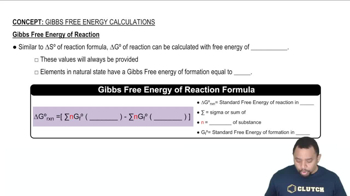
Gibbs Free Energy of Reactions

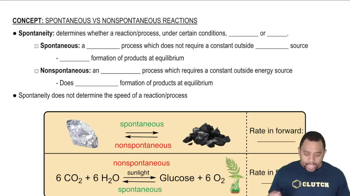
Spontaneity of Reactions

The spontaneity of a reaction refers to its ability to proceed without external intervention. A spontaneous process is characterized by a decrease in free energy (ΔG < 0), meaning it can occur naturally. Conversely, if ΔG is positive, the process is not spontaneous and requires energy input to occur.
Video consigliato:
Percorso guidato
04:20
Spontaneity of Processes

Thermodynamic Equilibrium

Thermodynamic equilibrium is the state of a system where macroscopic properties are uniform and do not change over time. At equilibrium, the Gibbs Free Energy is at a minimum, and any process that would increase ΔG is not spontaneous. A positive ΔG indicates that the system is not at equilibrium and will not proceed spontaneously in the forward direction.
Video consigliato:
Percorso guidato
01:18
First Law of Thermodynamics