
Indicate whether each statement is true or false. (a) ΔS is a state function. (b) If a system undergoes a reversible change, the entropy of the universe increases. (c) If a system undergoes a reversible process, the change in entropy of the system is exactly matched by an equal and opposite change in the entropy of the surroundings. (d) If a system undergoes a reversible process, the entropy change of the system must be zero.
Ch.19 - Chemical Thermodynamics

Brown15th EditionChemistry: The Central ScienceISBN: 9780137542970Non è quello che usi tu?Cambia libro di testo
Capitolo 19, Problema 17c
A system goes from state 1 to state 2 and back to state 1 following a reversible path in both directions. Which of the following statements about this process is or are true?
c. The value of w on going from state 1 to state 2 is equal in magnitude and opposite in sign to the value of w on going from state 2 back to state 1.
Guida verificata passo dopo passo1
Identify that the process described is a reversible cycle, meaning the system returns to its initial state.
Recall that in a reversible process, the work done (w) is path-dependent but the net change in state functions like internal energy (U) is zero over a complete cycle.
Understand that for a reversible cycle, the work done from state 1 to state 2 (w_1→2) and the work done from state 2 back to state 1 (w_2→1) must sum to zero because the system returns to its original state.
Express this mathematically as w_1→2 + w_2→1 = 0, which implies that w_1→2 = -w_2→1.
Conclude that the statement is true: the work done from state 1 to state 2 is equal in magnitude and opposite in sign to the work done from state 2 back to state 1.

Risposta video verificata per un problema simile:
Questa soluzione video è stata consigliata dai nostri tutor come utile per risolvere questo problema.
Durata del video:
1mConcetti chiave
Ecco i concetti essenziali che devi comprendere per rispondere correttamente alla domanda.
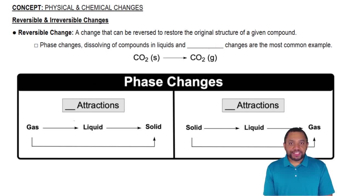
Reversible Processes
A reversible process is a thermodynamic process that can be reversed without leaving any trace on the surroundings. In such processes, the system and surroundings can be returned to their original states. This concept is crucial for understanding how energy and work are exchanged in a system, as it implies that the system can undergo changes in a controlled manner, allowing for the analysis of work done in both directions.
Video consigliato:
Percorso guidato
Reversible Changes in Matter
Work in Thermodynamics
In thermodynamics, work (denoted as 'w') is defined as the energy transferred when a force is applied over a distance. The sign of work is important: work done by the system on the surroundings is considered negative, while work done on the system is positive. Understanding this concept is essential for analyzing energy changes during reversible processes, particularly in determining the relationship between work done in both directions of a reversible path.
Video consigliato:
Percorso guidato
First Law of Thermodynamics
The First Law of Thermodynamics states that energy cannot be created or destroyed, only transformed from one form to another. This principle implies that the total energy change in a system is equal to the heat added to the system minus the work done by the system. In the context of reversible processes, this law helps to establish the relationship between the work done in both directions, reinforcing the idea that the work done going from state 1 to state 2 is equal in magnitude and opposite in sign to that going back.
Video consigliato:
Percorso guidato
First Law of Thermodynamics
Pratica correlata
Domanda del libro di testo
919
views
Domanda del libro di testo
Consider the vaporization of liquid water to steam at a pressure of 1 atm. (d) At what temperature are the two phases in equilibrium?
790
views
Domanda del libro di testo
The normal freezing point of n-octane (C8H18) is -57 °C. (b) In what temperature range is the freezing of n-octane a spontaneous process?
749
views
Domanda del libro di testo
The normal boiling point of Br2(l) is 58.8 °C, and its molar enthalpy of vaporization is ΔHvap = 29.6 kJ/mol. (a) When Br2(l) boils at its normal boiling point, does its entropy increase or decrease?
927
views
Domanda del libro di testo
The normal freezing point of n-octane (C8H18) is -57 °C. (d) Is there any temperature at which liquid n-octane and solid n-octane are in equilibrium? Explain.
613
views
