Ch.19 - Chemical Thermodynamics
Brown - Chemistry: The Central Science 15th Edition
Brown15th EditionChemistry: The Central ScienceISBN: 9780137542970Non è quello che usi tu?Cambia libro di testo
Capitolo 19, Problema 30a

(a) What is the difference between a state and a microstate of a system?

Guida verificata passo dopo passo
1
Understand that a 'state' of a system in thermodynamics refers to the macroscopic condition of the system, which is described by variables such as pressure, volume, temperature, and composition. These variables provide a comprehensive overview of the system at a macroscopic level.
Recognize that a 'microstate', on the other hand, refers to a specific detailed arrangement of each molecule in the system at any given instant. Microstates account for the positions and energies of all the molecules, which are not observable at the macroscopic level.
Learn that while the macroscopic state remains the same, the system can switch between countless microstates. For example, in a gas contained in a box, the overall temperature and pressure (macroscopic state) might be constant, but the individual positions and velocities of the gas molecules (microstates) are constantly changing.
Realize that the number of microstates is related to the entropy of the system, where a greater number of microstates corresponds to higher entropy. This relationship is quantified in statistical thermodynamics, which connects microscopic behavior with macroscopic properties.
Appreciate that understanding both the state and microstates of a system provides a more complete picture of the system's behavior from both a macroscopic and microscopic perspective, which is crucial for deeper insights in thermodynamics and statistical mechanics.

Risposta video verificata per un problema simile:

Questa soluzione video è stata consigliata dai nostri tutor come utile per risolvere questo problema.
Durata del video:
1m

Concetti chiave

Ecco i concetti essenziali che devi comprendere per rispondere correttamente alla domanda.

State of a System

A state of a system refers to the macroscopic properties that define the system at a given moment, such as temperature, pressure, and volume. These properties are measurable and provide a comprehensive description of the system's overall condition. For example, a gas in a container can be described by its temperature and pressure, which together define its state.
Video consigliato:
Percorso guidato
02:06
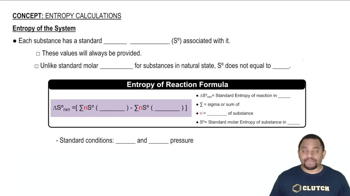
Entropy of the System

Microstate

A microstate is a specific configuration of a system at the microscopic level, detailing the exact positions and energies of all particles within the system. Each microstate corresponds to a particular arrangement of particles, and many microstates can correspond to the same macroscopic state. For instance, in a gas, the different ways in which molecules can be arranged while maintaining the same temperature and pressure represent different microstates.
Video consigliato:
Percorso guidato
01:23
The Boltzmann Equation

Statistical Mechanics

Statistical mechanics is a branch of physics that connects the microscopic properties of individual particles to the macroscopic properties of materials. It uses statistical methods to explain how the behavior of large numbers of particles leads to observable phenomena, such as temperature and pressure. This framework helps in understanding how many microstates correspond to a given state, thereby linking thermodynamics and quantum mechanics.
Video consigliato:
Percorso guidato
03:06
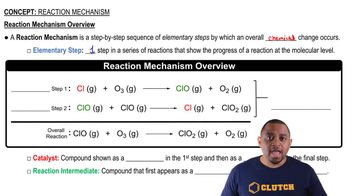
Reaction Mechanism Overview
Pratica correlata
Domanda del libro di testo

Would each of the following changes increase, decrease, or have no effect on the number of microstates available to a system: (b) decrease in volume

361
views

Domanda del libro di testo

For the isothermal expansion of a gas into a vacuum, ΔE = 0, q = 0, and w = 0. (b) Explain why no work is done by the system during this process.

1056
views
Domanda del libro di testo

(c) In a particular spontaneous process, the number of microstates available to the system decreases. What can you conclude about the sign of ΔSsurr?

421
views
Domanda del libro di testo

(a) What sign for Δ𝑆 do you expect when the pressure on 0.600 mol of an ideal gas at 350 K is increased isothermally from an initial pressure of 0.750 atm?

(b) If the final pressure on the gas is 1.20 atm, calculate the entropy change for the process.

(c) Which of the following statements about this process are true? (i) The entropy change you calculated will be the same for at any other constant temperature. (ii) The value of Δ𝑆 you calculated is valid only if the compression is done irreversibly. (iii) If the number of moles of gas being compressed were decreased by a factor of three, the entropy change would increase by a factor of three.

Domanda del libro di testo

(b) As a system goes from state A to state B, its entropy decreases. What can you say about the number of microstates corresponding to each state?

371
views
Domanda del libro di testo

(c) During a certain reversible process, the surroundings undergo an entropy change, ΔSsurr = -78 J/K. What is the entropy change of the system for this process?

436
views