Ch.19 - Chemical Thermodynamics
Brown - Chemistry: The Central Science 15th Edition
Brown15th EditionChemistry: The Central ScienceISBN: 9780137542970Non è quello che usi tu?Cambia libro di testo
Capitolo 19, Problema 30b

(b) As a system goes from state A to state B, its entropy decreases. What can you say about the number of microstates corresponding to each state?

Guida verificata passo dopo passo
1
Understand the concept of entropy in thermodynamics, which is a measure of the disorder or randomness in a system. It is related to the number of microstates (W), which are the different ways in which the system's particles can be arranged while still having the same total energy.
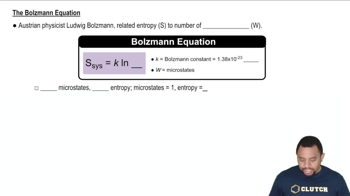
Recognize that entropy (S) is related to the number of microstates by the Boltzmann's equation, S = k \(\ln\)(W), where k is the Boltzmann constant and W is the number of microstates.
Identify that a decrease in entropy, as the system goes from state A to state B, implies that the number of microstates in state B is less than in state A. This is because a decrease in entropy suggests a decrease in disorder or randomness, meaning fewer possible arrangements of particles.
Conclude that since the entropy decreases from state A to state B, state A has more microstates compared to state B. This means that state A is more disordered or has more configurations at the microscopic level compared to state B.
Apply this understanding to predict the behavior of systems in different scenarios, considering how changes in entropy reflect changes in the number of microstates and thus the disorder of the system.

Risposta video verificata per un problema simile:

Questa soluzione video è stata consigliata dai nostri tutor come utile per risolvere questo problema.
Durata del video:
1m

Concetti chiave

Ecco i concetti essenziali che devi comprendere per rispondere correttamente alla domanda.

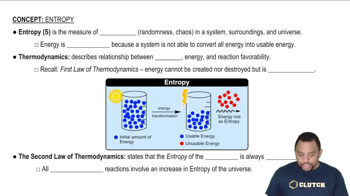
Entropy

Entropy is a measure of the disorder or randomness in a system. In thermodynamics, it quantifies the number of ways a system can be arranged at the microscopic level, with higher entropy indicating more disorder. When a system transitions from a state of higher entropy to lower entropy, it suggests a decrease in the number of accessible microstates.
Video consigliato:
Percorso guidato
02:46
Entropy in Thermodynamics

Microstates

Microstates refer to the specific configurations of a system at the molecular or atomic level that correspond to a particular macroscopic state. Each microstate represents a unique arrangement of particles, and the total number of microstates determines the entropy of the system. A decrease in entropy implies that the number of microstates available to the system has also decreased.
Video consigliato:
Percorso guidato
01:23
The Boltzmann Equation

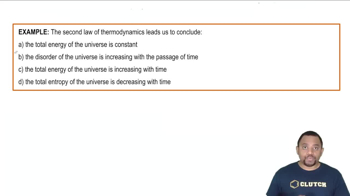
Second Law of Thermodynamics

The Second Law of Thermodynamics states that in an isolated system, the total entropy can never decrease over time. This law implies that processes tend to move towards a state of greater disorder. However, in specific scenarios, such as the transition from state A to state B, if the entropy decreases, it may indicate that the system is interacting with its surroundings, leading to a net increase in the entropy of the universe.
Video consigliato:
Percorso guidato
00:48
Second Law of Thermodynamics Example