Consider the decomposition of barium carbonate: BaCO3(s) ⇌ BaO(s) + CO2(g) Using data from Appendix C, calculate the equilibrium pressure of CO2 at (b) 1100 K.
Ch.19 - Chemical Thermodynamics

Brown15th EditionChemistry: The Central ScienceISBN: 9780137542970Non è quello che usi tu?Cambia libro di testo
Capitolo 19, Problema 81a
Consider the decomposition of barium carbonate: BaCO3(s) ⇌ BaO(s) + CO2(g) Using data from Appendix C, calculate the equilibrium pressure of CO2 at (a) 298 K.
Guida verificata passo dopo passo1
Identify the reaction: BaCO_3(s) \(\rightleftharpoons\) BaO(s) + CO_2(g).
Use the standard Gibbs free energy change (\(\Delta\) G^\(\circ\)) for the reaction to find the equilibrium constant (K) at 298 K. \(\Delta\) G^\(\circ\) = \(\sum\) \(\Delta\) G^\(\circ\)_{\(\text{products}\)} - \(\sum\) \(\Delta\) G^\(\circ\)_{\(\text{reactants}\)}.
Calculate \(\Delta\) G^\(\circ\) using the values from Appendix C for BaCO_3, BaO, and CO_2.
Relate \(\Delta\) G^\(\circ\) to the equilibrium constant using the equation \(\Delta\) G^\(\circ\) = -RT \(\ln\) K, where R is the gas constant (8.314 J/mol·K) and T is the temperature in Kelvin.
Solve for K, which is equal to the equilibrium pressure of CO_2, since the reaction involves only one gaseous product.

Risposta video verificata per un problema simile:
Questa soluzione video è stata consigliata dai nostri tutor come utile per risolvere questo problema.
Durata del video:
5mConcetti chiave
Ecco i concetti essenziali che devi comprendere per rispondere correttamente alla domanda.
Chemical Equilibrium
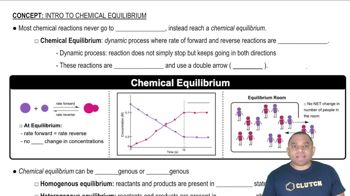
Chemical equilibrium occurs when the rates of the forward and reverse reactions are equal, resulting in constant concentrations of reactants and products. In the context of the decomposition of barium carbonate, the system reaches equilibrium when the amount of BaCO3 decomposing into BaO and CO2 is balanced by the amount of CO2 reacting back to form BaCO3.
Video consigliato:
Percorso guidato
Chemical Equilibrium Concepts
Equilibrium Constant (Kp)
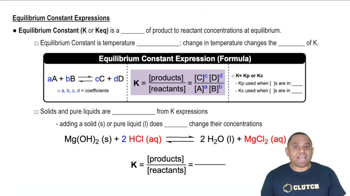
The equilibrium constant (Kp) for a gaseous reaction is defined in terms of the partial pressures of the products and reactants at equilibrium. For the decomposition of BaCO3, Kp can be expressed as the ratio of the partial pressure of CO2 to the concentration of BaCO3 and BaO, allowing for the calculation of the equilibrium pressure of CO2 at a given temperature.
Video consigliato:
Percorso guidato
Equilibrium Constant Expressions
Ideal Gas Law
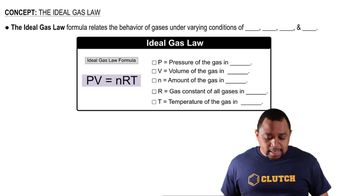
The Ideal Gas Law (PV=nRT) relates the pressure, volume, temperature, and number of moles of a gas. In this scenario, it can be used to determine the pressure of CO2 at equilibrium by rearranging the equation to solve for pressure (P) when the number of moles and temperature are known, providing a practical approach to finding the equilibrium pressure in the reaction.
Video consigliato:
Percorso guidato
Ideal Gas Law Formula
Pratica correlata
Domanda del libro di testo
666
views
Domanda del libro di testo
Consider the reaction 3 CH4(g) → C3H8(g) + 2 H2(g). (b) Calculate ΔG at 298 K if the reaction mixture consists of 40.0 atm of CH4, 0.0100 atm of C3H8(g), and 0.0180 atm of H2.
685
views
Domanda del libro di testo
The value of Ka for nitrous acid (HNO2) at 25 °C is given in Appendix D. (a) Write the chemical equation for the equilibrium that corresponds to Ka.
573
views
Domanda del libro di testo
Using data from Appendix C, write the equilibrium-constant expression and calculate the value of the equilibrium constant and the free-energy change for these reactions at 298 K: (a) NaHCO3(s) ⇌ NaOH(s) + CO2(g)
1056
views
Domanda del libro di testo
Consider the reaction PbCO3(s) ⇌ PbO(s) + CO2(g) Using data in Appendix C, calculate the equilibrium pressure of CO2 in the system at (a) 400 °C (b) 180 °C.
1209
views
1
rank