Consider the reaction 3 CH4(g) → C3H8(g) + 2 H2(g). (a) Using data from Appendix C, calculate ΔG° at 298 K.
Ch.19 - Chemical Thermodynamics

Brown15th EditionChemistry: The Central ScienceISBN: 9780137542970Non è quello che usi tu?Cambia libro di testo
Capitolo 19, Problema 80a
Using data from Appendix C, write the equilibrium-constant expression and calculate the value of the equilibrium constant and the free-energy change for these reactions at 298 K: (a) NaHCO3(s) ⇌ NaOH(s) + CO2(g)
Guida verificata passo dopo passo1
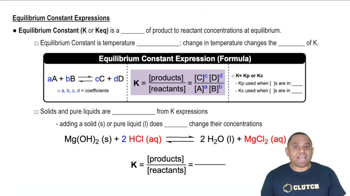
Write the equilibrium constant expression for the reaction. For the reaction NaHCO3(s) ⇌ NaOH(s) + CO2(g), the equilibrium constant expression (K) is defined by the concentrations of the products raised to their stoichiometric coefficients divided by the concentrations of the reactants raised to their stoichiometric coefficients. Since NaHCO3(s) and NaOH(s) are solids, their concentrations remain constant and do not appear in the expression. Thus, K = [CO2].
Look up the standard Gibbs free energy of formation (ΔG°f) for each species involved in the reaction at 298 K from Appendix C. You will need the values for NaHCO3(s), NaOH(s), and CO2(g).
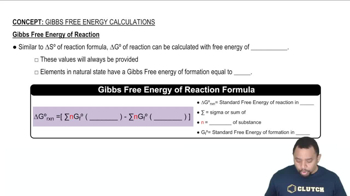
Calculate the standard Gibbs free energy change for the reaction (ΔG°rxn) using the formula ΔG°rxn = ΣΔG°f(products) - ΣΔG°f(reactants). Here, you will substitute the ΔG°f values of NaOH(s) and CO2(g) as products and NaHCO3(s) as the reactant.
Use the relationship between the equilibrium constant and the Gibbs free energy change to find the equilibrium constant. The formula to use is ΔG°rxn = -RT ln(K), where R is the gas constant (8.314 J/mol·K) and T is the temperature in Kelvin (298 K). Solve for K by rearranging the formula to K = e^(-ΔG°rxn / (RT)).
Substitute the values of ΔG°rxn, R, and T into the formula to calculate the value of the equilibrium constant, K.

Risposta video verificata per un problema simile:
Questa soluzione video è stata consigliata dai nostri tutor come utile per risolvere questo problema.
Durata del video:
3mConcetti chiave
Ecco i concetti essenziali che devi comprendere per rispondere correttamente alla domanda.
Equilibrium Constant Expression
The equilibrium constant expression (K) quantifies the ratio of the concentrations of products to reactants at equilibrium for a given reaction. It is derived from the balanced chemical equation, where the concentrations of gaseous and aqueous species are included, while solids and liquids are omitted. For the reaction NaHCO3(s) ⇌ NaOH(s) + CO2(g), K would be expressed in terms of the partial pressure of CO2 since NaHCO3 and NaOH are solids.
Video consigliato:
Percorso guidato
Equilibrium Constant Expressions
Calculating Equilibrium Constant
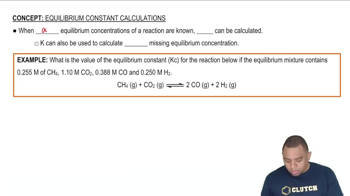
To calculate the equilibrium constant, one must know the concentrations or partial pressures of the reactants and products at equilibrium. For the reaction in question, once the equilibrium concentrations are determined, K can be calculated using the formula K = [products]/[reactants]. This value provides insight into the extent of the reaction and its favorability under the given conditions.
Video consigliato:
Percorso guidato
Equilibrium Constant Calculation
Gibbs Free Energy Change
Gibbs free energy change (ΔG) indicates the spontaneity of a reaction at constant temperature and pressure. It is related to the equilibrium constant by the equation ΔG = -RT ln(K), where R is the universal gas constant and T is the temperature in Kelvin. A negative ΔG suggests that the reaction is spontaneous, while a positive ΔG indicates non-spontaneity. This relationship helps in understanding the thermodynamic favorability of the reaction at 298 K.
Video consigliato:
Percorso guidato
Gibbs Free Energy of Reactions
Pratica correlata
Domanda del libro di testo
437
views
Domanda del libro di testo
Consider the decomposition of barium carbonate: BaCO3(s) ⇌ BaO(s) + CO2(g) Using data from Appendix C, calculate the equilibrium pressure of CO2 at (b) 1100 K.
666
views
Domanda del libro di testo
Consider the decomposition of barium carbonate: BaCO3(s) ⇌ BaO(s) + CO2(g) Using data from Appendix C, calculate the equilibrium pressure of CO2 at (a) 298 K.
1184
views
2
rank
Domanda del libro di testo
Consider the reaction 3 CH4(g) → C3H8(g) + 2 H2(g). (b) Calculate ΔG at 298 K if the reaction mixture consists of 40.0 atm of CH4, 0.0100 atm of C3H8(g), and 0.0180 atm of H2.
685
views
Domanda del libro di testo
Consider the reaction PbCO3(s) ⇌ PbO(s) + CO2(g) Using data in Appendix C, calculate the equilibrium pressure of CO2 in the system at (a) 400 °C (b) 180 °C.
1209
views
1
rank