Ch.19 - Chemical Thermodynamics
Brown - Chemistry: The Central Science 15th Edition
Brown15th EditionChemistry: The Central ScienceISBN: 9780137542970Non è quello che usi tu?Cambia libro di testo
Capitolo 19, Problema 99b

The conversion of natural gas, which is mostly methane, into products that contain two or more carbon atoms, such as ethane (C2H6), is a very important industrial chemical process. In principle, methane can be converted into ethane and hydrogen: 2 CH4(g) → C2H6(g) + H2(g) In practice, this reaction is carried out in the presence of oxygen: 2 CH4(g) + 12 O2(g) → C2H6(g) + H2O(g) (b) Is the difference in ΔG° for the two reactions due primarily to the enthalpy term (ΔH) or the entropy term (-TΔS)?

Guida verificata passo dopo passo
1
Identify the reactions involved and write down their balanced chemical equations. For the first reaction: 2 CH4(g) → C2H6(g) + H2(g). For the second reaction: 2 CH4(g) + 12 O2(g) → C2H6(g) + H2O(g).
Understand the Gibbs free energy change (ΔG°) for a reaction, which is given by the equation ΔG° = ΔH° - TΔS°, where ΔH° is the change in enthalpy, T is the temperature in Kelvin, and ΔS° is the change in entropy.
Analyze the enthalpy change (ΔH°) for both reactions. The addition of oxygen in the second reaction likely increases the exothermic nature of the reaction, thus decreasing ΔH° (making it more negative).
Consider the entropy change (ΔS°) for both reactions. The second reaction produces fewer gas molecules (1 mole of water vapor) compared to the first reaction (1 mole of hydrogen gas), which might decrease the entropy.
Compare the magnitude of changes in ΔH° and -TΔS° for both reactions to determine which term contributes more significantly to the difference in ΔG°. A larger change in ΔH° suggests that the enthalpy term is more influential, whereas a larger change in -TΔS° suggests that the entropy term is more influential.

Risposta video verificata per un problema simile:

Questa soluzione video è stata consigliata dai nostri tutor come utile per risolvere questo problema.
Durata del video:
5m

Concetti chiave

Ecco i concetti essenziali che devi comprendere per rispondere correttamente alla domanda.

Gibbs Free Energy (ΔG)

Gibbs Free Energy (ΔG) is a thermodynamic potential that measures the maximum reversible work obtainable from a thermodynamic system at constant temperature and pressure. It combines the system's enthalpy (ΔH) and entropy (ΔS) to determine spontaneity; a negative ΔG indicates a spontaneous process. Understanding ΔG is crucial for analyzing chemical reactions, particularly in determining whether a reaction will proceed under given conditions.
Video consigliato:
Percorso guidato
01:51
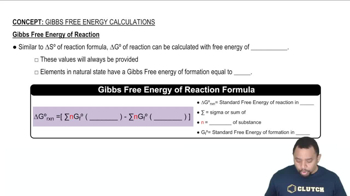
Gibbs Free Energy of Reactions

Enthalpy (ΔH)

Enthalpy (ΔH) is a measure of the total heat content of a system, reflecting the energy required to create the system and the energy associated with the pressure and volume of the system. In chemical reactions, ΔH can indicate whether a reaction is exothermic (releases heat) or endothermic (absorbs heat). The change in enthalpy is a key factor in determining the overall energy change during a reaction, influencing the ΔG value.
Video consigliato:
Percorso guidato
02:34
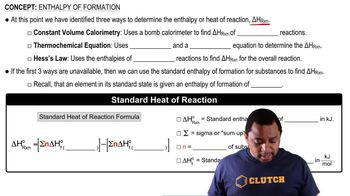
Enthalpy of Formation

Entropy (ΔS)

Entropy (ΔS) is a measure of the disorder or randomness in a system. It reflects the number of ways a system can be arranged, with higher entropy indicating greater disorder. In the context of chemical reactions, changes in entropy can significantly affect the spontaneity of a reaction, especially when combined with temperature (as seen in the term -TΔS in the Gibbs Free Energy equation). Understanding entropy is essential for evaluating the driving forces behind chemical processes.
Video consigliato:
Percorso guidato
02:46
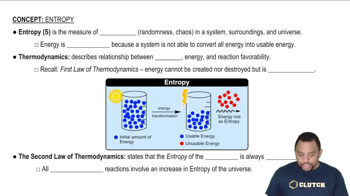
Entropy in Thermodynamics
Pratica correlata
Domanda del libro di testo

(c) In each case, indicate whether K should increase or decrease with increasing temperature. (i) 2 Mg(s) + O2 (g) ⇌ 2 MgO(s) (ii) 2 KI(s) ⇌ 2 K(g) + I2(g) (iii) Na2(g) ⇌ 2 Na(g) (iv) 2 V2O5(s) ⇌ 4 V(s) + 5 O2(g)

Domanda del libro di testo

Consider the following equilibrium: N2O4(g) ⇌ 2 NO2(g) Thermodynamic data on these gases are given in Appendix C. You may assume that ΔH° and ΔS° do not vary with temperature. (a) At what temperature will an equilibrium mixture contain equal amounts of the two gases?

1162
views
1
rank
Domanda del libro di testo

The potassium-ion concentration in blood plasma is about 5.0⨉10-3 M, whereas the concentration in muscle-cell fluid is much greater (0.15 M ). The plasma and intracellular fluid are separated by the cell membrane, which we assume is permeable only to K+. (a) What is ΔG for the transfer of 1 mol of K+ from blood plasma to the cellular fluid at body temperature 37 °C? (b) What is the minimum amount of work that must be used to transfer this K+?

1097
views
1
rank
Domanda del libro di testo

At what temperatures is the following reaction, the reduction of magnetite by graphite to elemental iron, spontaneous? Fe3O4(s) + 2 C(s, graphite) → 2 CO2(g) + 3 Fe(s)

795
views
1
comments
Domanda del libro di testo

(a) For each of the following reactions, predict the sign of ΔH° and ΔS° without doing any calculations. (i) 2 Mg(s) + O2 (g) ⇌ 2 MgO(s) (ii) 2 KI(s) ⇌ 2 K(g) + I2(g) (iii) Na2(g) ⇌ 2 Na(g) (iv) 2 V2O5(s) ⇌ 4 V(s) + 5 O2(g)

860
views
Domanda del libro di testo

(b) Based on your general chemical knowledge, predict which of these reactions will have K>1. (i) 2 Mg(s) + O2 (g) ⇌ 2 MgO(s) (ii) 2 KI(s) ⇌ 2 K(g) + I2(g) (iii) Na2(g) ⇌ 2 Na(g) (iv) 2 V2O5(s) ⇌ 4 V(s) + 5 O2(g)

369
views