Ch.19 - Chemical Thermodynamics
Brown - Chemistry: The Central Science 15th Edition
Brown15th EditionChemistry: The Central ScienceISBN: 9780137542970Non è quello che usi tu?Cambia libro di testo
Capitolo 19, Problema 101

The potassium-ion concentration in blood plasma is about 5.0⨉10-3 M, whereas the concentration in muscle-cell fluid is much greater (0.15 M ). The plasma and intracellular fluid are separated by the cell membrane, which we assume is permeable only to K+. (a) What is ΔG for the transfer of 1 mol of K+ from blood plasma to the cellular fluid at body temperature 37 °C? (b) What is the minimum amount of work that must be used to transfer this K+?

Guida verificata passo dopo passo
1
Calculate the change in Gibbs free energy (ΔG) using the formula: ΔG = -RT \(\ln\[\left\)(\(\frac{C_2}{C_1}\]\right\)), where R is the gas constant (8.314 J/mol·K), T is the temperature in Kelvin, C_1 is the initial concentration of K+ in the blood plasma, and C_2 is the final concentration of K+ in the muscle-cell fluid.
Convert the body temperature from Celsius to Kelvin by adding 273.15 to the Celsius temperature. This is necessary because the formula for ΔG requires the temperature to be in Kelvin.
Substitute the values into the formula: R = 8.314 J/mol·K, T = 310.15 K (37 °C + 273.15), C_1 = 5.0⨉10-3 M, and C_2 = 0.15 M.
Calculate the natural logarithm (ln) of the ratio of the concentrations (C_2/C_1).
The result from the ΔG calculation will give the minimum amount of work that must be used to transfer 1 mol of K+ from blood plasma to the cellular fluid, as ΔG also represents the maximum non-expansion work that can be done by a system at constant temperature and pressure.

Risposta video verificata per un problema simile:

Questa soluzione video è stata consigliata dai nostri tutor come utile per risolvere questo problema.
Durata del video:
2m

Concetti chiave

Ecco i concetti essenziali che devi comprendere per rispondere correttamente alla domanda.

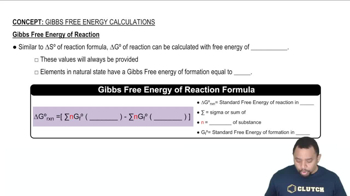
Gibbs Free Energy (ΔG)

Gibbs Free Energy (ΔG) is a thermodynamic potential that measures the maximum reversible work obtainable from a thermodynamic system at constant temperature and pressure. It is calculated using the formula ΔG = ΔG° + RT ln(Q), where ΔG° is the standard free energy change, R is the universal gas constant, T is the temperature in Kelvin, and Q is the reaction quotient. A negative ΔG indicates a spontaneous process, while a positive ΔG suggests non-spontaneity.
Video consigliato:
Percorso guidato
01:51
Gibbs Free Energy of Reactions

Concentration Gradient

A concentration gradient refers to the difference in the concentration of a substance across a space or membrane. In this context, the gradient exists between the potassium ion concentrations in blood plasma (5.0×10^-3 M) and muscle-cell fluid (0.15 M). Ions tend to move from areas of higher concentration to areas of lower concentration, and this movement is crucial for understanding the direction and spontaneity of ion transfer across membranes.
Video consigliato:
Percorso guidato
07:35
Calculate Concentration of the Basic Form

Work and Energy Transfer

In thermodynamics, work is defined as the energy transferred when an object is moved by an external force. The minimum amount of work required to transfer ions against their concentration gradient can be calculated using the relationship between Gibbs Free Energy and work. Specifically, the work done on the system is equal to the change in Gibbs Free Energy, which reflects the energy needed to move ions from a region of lower concentration to a region of higher concentration.
Video consigliato:
Percorso guidato
01:52
Work Function Calculation Example
Pratica correlata
Domanda del libro di testo

(c) In each case, indicate whether K should increase or decrease with increasing temperature. (i) 2 Mg(s) + O2 (g) ⇌ 2 MgO(s) (ii) 2 KI(s) ⇌ 2 K(g) + I2(g) (iii) Na2(g) ⇌ 2 Na(g) (iv) 2 V2O5(s) ⇌ 4 V(s) + 5 O2(g)

Domanda del libro di testo

The reaction SO2(g) + 2 H2S(g) ⇌ 3 S(s) + 2 H2O(g) is the basis of a suggested method for removal of SO2 from power-plant stack gases. The standard free energy of each substance is given in Appendix C. (a) What is the equilibrium constant for the reaction at 298 K? (c) If PSO2 = PH2S and the vapor pressure of water is 25 torr, calculate the equilibrium SO2 pressure in the system at 298 K.

488
views
Domanda del libro di testo

Consider the following equilibrium: N2O4(g) ⇌ 2 NO2(g) Thermodynamic data on these gases are given in Appendix C. You may assume that ΔH° and ΔS° do not vary with temperature. (a) At what temperature will an equilibrium mixture contain equal amounts of the two gases?

1162
views
1
rank
Domanda del libro di testo

At what temperatures is the following reaction, the reduction of magnetite by graphite to elemental iron, spontaneous? Fe3O4(s) + 2 C(s, graphite) → 2 CO2(g) + 3 Fe(s)

795
views
1
comments
Domanda del libro di testo

The conversion of natural gas, which is mostly methane, into products that contain two or more carbon atoms, such as ethane (C2H6), is a very important industrial chemical process. In principle, methane can be converted into ethane and hydrogen: 2 CH4(g) → C2H6(g) + H2(g) In practice, this reaction is carried out in the presence of oxygen: 2 CH4(g) + 12 O2(g) → C2H6(g) + H2O(g) (b) Is the difference in ΔG° for the two reactions due primarily to the enthalpy term (ΔH) or the entropy term (-TΔS)?

407
views
Domanda del libro di testo

(b) Based on your general chemical knowledge, predict which of these reactions will have K>1. (i) 2 Mg(s) + O2 (g) ⇌ 2 MgO(s) (ii) 2 KI(s) ⇌ 2 K(g) + I2(g) (iii) Na2(g) ⇌ 2 Na(g) (iv) 2 V2O5(s) ⇌ 4 V(s) + 5 O2(g)

369
views