Ch.2 - Atoms, Molecules, and Ions
Brown - Chemistry: The Central Science 15th Edition
Brown15th EditionChemistry: The Central ScienceISBN: 9780137542970Non è quello che usi tu?Cambia libro di testo
Capitolo 2, Problema 13a1

A chemist finds that 30.82 g of nitrogen will react with 17.60, 35.20, 70.40, or 88.00 g of oxygen to form four different compounds. (a) Calculate the mass of oxygen per gram of nitrogen in each compound. 30.82 g N and 17.60 g O

Guida verificata passo dopo passo
1
Determine the mass of nitrogen given for the reaction, which is 30.82 grams.
Identify the mass of oxygen that reacts with the nitrogen in the first compound, which is 17.60 grams.
Calculate the mass ratio of oxygen to nitrogen for the compound by dividing the mass of oxygen by the mass of nitrogen.
Use the formula: Mass ratio = \( \frac{\text{mass of oxygen}}{\text{mass of nitrogen}} \).
Plug in the values: Mass ratio = \( \frac{17.60 \, \text{g}}{30.82 \, \text{g}} \) to find the mass of oxygen per gram of nitrogen in the first compound.

Risposta video verificata per un problema simile:

Questa soluzione video è stata consigliata dai nostri tutor come utile per risolvere questo problema.
Durata del video:
1m

Concetti chiave

Ecco i concetti essenziali che devi comprendere per rispondere correttamente alla domanda.

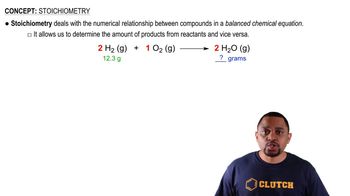
Stoichiometry

Stoichiometry is the branch of chemistry that deals with the quantitative relationships between the reactants and products in a chemical reaction. It allows chemists to calculate the amounts of substances consumed and produced in a reaction based on balanced chemical equations. Understanding stoichiometry is essential for determining how much oxygen reacts with a given mass of nitrogen in this scenario.
Video consigliato:
Percorso guidato
01:16
Stoichiometry Concept

Mass Ratio

The mass ratio is a comparison of the mass of one substance to the mass of another substance in a chemical reaction. In this case, it refers to the mass of oxygen per gram of nitrogen. Calculating this ratio helps in understanding the composition of the compounds formed and is crucial for analyzing the different amounts of oxygen that react with a fixed mass of nitrogen.
Video consigliato:
Percorso guidato
02:14
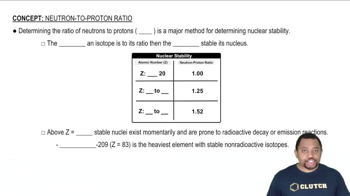
Neutron-Proton Ratio

Chemical Compounds

Chemical compounds are substances formed when two or more elements chemically bond together in fixed proportions. The different amounts of oxygen reacting with nitrogen in this question indicate the formation of various nitrogen-oxygen compounds, each with distinct properties. Recognizing how these compounds differ based on their elemental ratios is key to interpreting the results of the experiment.
Video consigliato:
Percorso guidato
03:31
Chemical Properties
Pratica correlata
Domanda del libro di testo

A chemist finds that 30.82 g of nitrogen will react with 17.60, 35.20, 70.40, or 88.00 g of oxygen to form four different compounds. (b) How do the numbers in part (a) support Dalton's atomic theory?

895
views

Domanda del libro di testo

A chemist finds that 30.82 g of nitrogen will react with 17.60, 35.20, 70.40, or 88.00 g of oxygen to form four different compounds. (a) Calculate the mass of oxygen per gram of nitrogen in each compound. 30.82 g N and 70.40 g O

371
views
Domanda del libro di testo

Hydrogen sulfide is composed of two elements: hydrogen and sulfur. In an experiment, 6.500 g of hydrogen sulfide is fully decomposed into its elements. b. What fundamental law does this experiment demonstrate?

6
views
Domanda del libro di testo

A chemist finds that 30.82 g of nitrogen will react with 17.60, 35.20, 70.40, or 88.00 g of oxygen to form four different compounds. (a) Calculate the mass of oxygen per gram of nitrogen in each compound. 30.82 g N and 35.20 g O

505
views
Domanda del libro di testo

In a series of experiments, a chemist prepared three different compounds that contain only iodine and fluorine and determined the mass of each element in each compound: Compound Mass of Iodine (g) Mass of Fluorine (g) 1 4.75 3.56 2 7.64 3.43 3 9.41 9.86 (a) Calculate the mass of fluorine per gram of iodine in Compound 1 and 2.

882
views
Domanda del libro di testo

A chemist finds that 30.82 g of nitrogen will react with 17.60, 35.20, 70.40, or 88.00 g of oxygen to form four different compounds. (a) Calculate the mass of oxygen per gram of nitrogen in each compound. 30.82 g N and 88.00 g O

1274
views