
The following diagram is a representation of 20 atoms of a fictitious element, which we will call nevadium (Nv). The red spheres are 293Nv, and the blue spheres are 295Nv. (a) Assuming that this sample is a statistically representative sample of the element, calculate the percent abundance of each element.
Ch.2 - Atoms, Molecules, and Ions

Brown15th EditionChemistry: The Central ScienceISBN: 9780137542970Non è quello che usi tu?Cambia libro di testo
Capitolo 2, Problema 4a
Does the following drawing represent a neutral atom or an ion?

Guida verificata passo dopo passo1
Identify the number of protons in the nucleus. In this case, there are 8 protons.
Identify the number of electrons surrounding the nucleus. In this case, there are 10 electrons.
Compare the number of protons and electrons. A neutral atom has an equal number of protons and electrons.
Since there are more electrons (10) than protons (8), the atom has a net negative charge.
Conclude that the atom is an ion, specifically an anion, because it has more electrons than protons.

Risposta video verificata per un problema simile:
Questa soluzione video è stata consigliata dai nostri tutor come utile per risolvere questo problema.
Durata del video:
2mConcetti chiave
Ecco i concetti essenziali che devi comprendere per rispondere correttamente alla domanda.
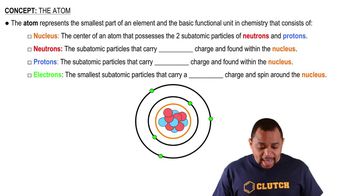
Atomic Structure
An atom consists of a nucleus containing protons and neutrons, surrounded by electrons in defined energy levels. Protons are positively charged, neutrons are neutral, and electrons are negatively charged. The number of protons determines the element, while the arrangement of electrons influences chemical behavior.
Video consigliato:
Percorso guidato
Atom Structure
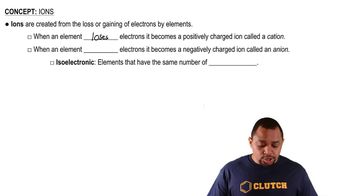
Neutral Atoms vs. Ions
A neutral atom has an equal number of protons and electrons, resulting in no overall charge. An ion, however, is formed when an atom gains or loses electrons, leading to a net positive or negative charge. In the provided diagram, the presence of 10 electrons and 8 protons indicates that the atom is negatively charged, thus making it an ion.
Video consigliato:
Percorso guidato
Atoms vs. Ions
Charge Calculation
The charge of an atom can be calculated by subtracting the number of electrons from the number of protons. If the result is zero, the atom is neutral; if positive, it is a cation (loss of electrons); if negative, it is an anion (gain of electrons). In this case, with 10 electrons and 8 protons, the charge is -2, confirming it is an anion.
Video consigliato:
Percorso guidato
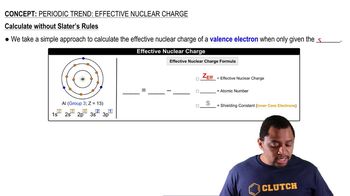
Effective Nuclear Charge Calculation
Pratica correlata
Domanda del libro di testo
1477
views
Domanda del libro di testo
Five of the boxes in the following periodic table are colored. Predict the charge on the ion associated with each of these elements.
355
views
Domanda del libro di testo
The following diagram is a representation of 20 atoms of a fictitious element, which we will call nevadium (Nv). The red spheres are 293Nv, and the blue spheres are 295Nv. (b) If the mass of 293Nv is 293.15 u and that of 295Nv is 295.15 u, what is the atomic weight of Nv?
511
views
1
rank
Domanda del libro di testo
Four of the boxes in the following periodic table are colored. Which of these are metals and which are nonmetals?
372
views
Domanda del libro di testo
a. Which of the following diagrams most likely represents an ionic compound?
b. Which of the following diagrams most likely represents a molecular compound?
3
views
