
In the Millikan oil-drop experiment (see Figure 2.5), the tiny oil drops are observed through the viewing lens as rising, stationary, or falling, as shown here. The arrows indicate the rate of motion. a. What causes their rate of fall to vary from their rate in the absence of an electric field?
Ch.2 - Atoms, Molecules, and Ions

Brown15th EditionChemistry: The Central ScienceISBN: 9780137542970Non è quello che usi tu?Cambia libro di testo
Capitolo 2, Problema 7
Five of the boxes in the following periodic table are colored. Predict the charge on the ion associated with each of these elements.
Guida verificata passo dopo passo1
Identify the position of each colored element in the periodic table to determine its group number.
Recall that elements in the same group typically form ions with the same charge due to having the same number of valence electrons.
For main group elements, use the group number to predict the charge: elements in Group 1 form +1 ions, Group 2 form +2 ions, Group 13 form +3 ions, Group 15 form -3 ions, Group 16 form -2 ions, and Group 17 form -1 ions.
Consider any exceptions or special cases, such as transition metals, which may have multiple possible charges.
Write down the predicted charge for each element based on its group and typical ion formation behavior.

Risposta video verificata per un problema simile:
Questa soluzione video è stata consigliata dai nostri tutor come utile per risolvere questo problema.
Durata del video:
1mConcetti chiave
Ecco i concetti essenziali che devi comprendere per rispondere correttamente alla domanda.
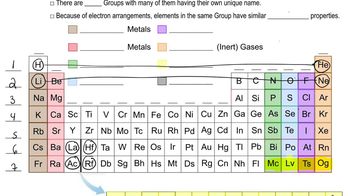
Periodic Table and Element Groups
The periodic table organizes elements based on their atomic number and properties. Elements are grouped into columns (groups) that share similar chemical behaviors. For example, alkali metals in Group 1 typically form +1 ions, while halogens in Group 17 usually form -1 ions. Understanding an element's position in the periodic table helps predict its ionic charge.
Video consigliato:
Percorso guidato
Periodic Table: Group Names
Ionic Charge and Electron Configuration
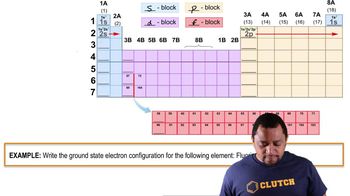
Ionic charge refers to the electrical charge an atom acquires when it loses or gains electrons to achieve a stable electron configuration, often resembling that of noble gases. Metals tend to lose electrons and form positive ions (cations), while nonmetals gain electrons to form negative ions (anions). This concept is crucial for predicting the charges of ions formed by different elements.
Video consigliato:
Percorso guidato
Electron Configuration Example
Trends in Ionic Charges
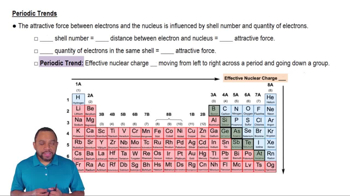
Ionic charges exhibit predictable trends across the periodic table. For instance, elements in the same group often form ions with the same charge due to their similar valence electron configurations. Additionally, as you move from left to right across a period, the tendency to gain electrons increases, leading to more negative charges for nonmetals. Recognizing these trends aids in accurately predicting the charges of ions.
Video consigliato:
Percorso guidato
Effective Nuclear Charge Trends
Pratica correlata
Domanda del libro di testo
6
views
Domanda del libro di testo
A 1.0-g sample of carbon dioxide (CO2) is fully decomposed into its elements, yielding 0.273 g of carbon and 0.727 g of oxygen. (a) What is the ratio of the mass of O to C?
753
views
Domanda del libro di testo
Does the following drawing represent a neutral atom or an ion?
1280
views
Domanda del libro di testo
The following diagram represents an ionic compound in which the red spheres represent cations and the blue spheres represent anions. Which of the following compounds is consistent with the drawing?
a. potassium bromide
b. potassium sulfate
c. calcium nitrate
d. iron(III) sulfate
2
views
Domanda del libro di testo
a. Which of the following diagrams most likely represents an ionic compound?
b. Which of the following diagrams most likely represents a molecular compound?
3
views
