
Ch.2 - Atoms, Molecules, and Ions
Brown - Chemistry: The Central Science 15th Edition
Brown15th EditionChemistry: The Central ScienceISBN: 9780137542970Non è quello che usi tu?Cambia libro di testo
Capitolo 2, Problema 102

From the following list of elements—Ar, H, Ga, Al, Ca, Br, Ge, K, O—pick the one that best fits each description. Use each element only once: (a) an alkali metal, (b) an alkaline earth metal, (c) a noble gas, (d) a halogen, (e) a metalloid, (f) a nonmetal listed in group 1A, (g) a metal that forms a 3+ ion, (h) a nonmetal that forms a 2- ion, (i) an element that resembles aluminum.

Guida verificata passo dopo passo
1
Identify the alkali metal: Alkali metals are found in Group 1 of the periodic table. Look for an element in the list that belongs to this group.
Identify the alkaline earth metal: Alkaline earth metals are located in Group 2 of the periodic table. Find the element in the list that fits this category.
Identify the noble gas: Noble gases are in Group 18 of the periodic table. Determine which element from the list is a noble gas.
Identify the halogen: Halogens are found in Group 17 of the periodic table. Select the element from the list that is a halogen.
Identify the metalloid: Metalloids have properties intermediate between metals and nonmetals. Choose the element from the list that is a metalloid.

Risposta video verificata per un problema simile:

Questa soluzione video è stata consigliata dai nostri tutor come utile per risolvere questo problema.
Durata del video:
2m

Concetti chiave

Ecco i concetti essenziali che devi comprendere per rispondere correttamente alla domanda.

Periodic Table Groups

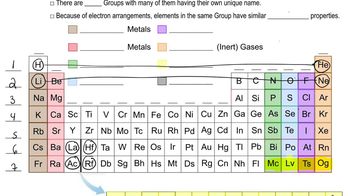
The periodic table is organized into groups (columns) that share similar chemical properties. For example, Group 1A contains alkali metals like potassium (K), while Group 2A contains alkaline earth metals like calcium (Ca). Understanding these groups helps identify elements based on their characteristics, such as reactivity and ionization behavior.
Video consigliato:
Percorso guidato
05:33
Periodic Table: Group Names

Element Categories

Elements can be categorized as metals, nonmetals, or metalloids based on their properties. Metals, such as aluminum (Al), are typically good conductors of heat and electricity, while nonmetals, like oxygen (O), are poor conductors and can form negative ions. Metalloids, such as germanium (Ge), exhibit properties of both metals and nonmetals, making them unique in their applications.
Video consigliato:
Percorso guidato
02:35
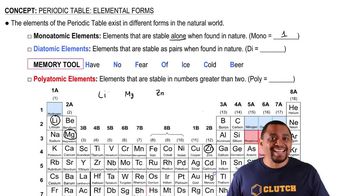
Elemental Forms of Elements

Ionic Charges and Formation

Elements can form ions by gaining or losing electrons, resulting in positive or negative charges. For instance, nonmetals like oxygen (O) typically gain electrons to form anions with a 2- charge, while metals like aluminum (Al) can lose electrons to form cations with a 3+ charge. Recognizing these tendencies is crucial for predicting how elements will interact in chemical reactions.
Video consigliato:
Percorso guidato
02:34
Enthalpy of Formation
Pratica correlata
Domanda del libro di testo

There are two different isotopes of bromine atoms. Under normal conditions, elemental bromine consists of molecules, and the mass of a molecule is the sum of the masses of the two atoms in the molecule. The mass spectrum of consists of three peaks: m/zRelative Peak Intensity157.836 0.2569 159.834 0.4999 161.832 0.2431

e. Calculate the abundances of the two isotopes.

2
views
Domanda del libro di testo

The first atoms of seaborgium (Sg) were identified in 1974. The longest-lived isotope of Sg has a mass number of 266. (a) How many protons, electrons, and neutrons are in an 266Sg atom?

666
views
Domanda del libro di testo

From the molecular structures shown here, identify the one that corresponds to each of the following species: (a) chlorine gas; (b) propane; (c) nitrate ion; (d) sulfur trioxide; (e) methyl chloride, CH3Cl.

383
views
Domanda del libro di testo

The first atoms of seaborgium (Sg) were identified in 1974. The longest-lived isotope of Sg has a mass number of 266. (b) Atoms of Sg are very unstable, and it is therefore difficult to study this element's properties. Based on the position of Sg in the periodic table, what element should it most closely resemble in its chemical properties?

566
views
Domanda del libro di testo

There are two different isotopes of bromine atoms. Under normal conditions, elemental bromine consists of molecules, and the mass of a molecule is the sum of the masses of the two atoms in the molecule. The mass spectrum of consists of three peaks: m/zRelative Peak Intensity157.836 0.2569 159.834 0.4999 161.832 0.2431

d. Determine the average atomic mass of a bromine atom.

2
views
Domanda del libro di testo

It is common in mass spectrometry to assume that the mass of a cation is the same as that of its parent atom. (b) What percentage of the mass of an 1H atom does the electron represent?

305
views