
Ch.2 - Atoms, Molecules, and Ions
Brown - Chemistry: The Central Science 15th Edition
Brown15th EditionChemistry: The Central ScienceISBN: 9780137542970Non è quello che usi tu?Cambia libro di testo
Capitolo 2, Problema 100d

There are two different isotopes of bromine atoms. Under normal conditions, elemental bromine consists of molecules, and the mass of a molecule is the sum of the masses of the two atoms in the molecule. The mass spectrum of consists of three peaks: m/zRelative Peak Intensity157.836 0.2569 159.834 0.4999 161.832 0.2431
d. Determine the average atomic mass of a bromine atom.

Guida verificata passo dopo passo
1
Identify the isotopes of bromine involved in the molecule. The peaks in the mass spectrum correspond to different combinations of these isotopes.
Recognize that the mass spectrum peaks represent the mass-to-charge ratio (m/z) of the bromine molecules, which are diatomic (Br2).
Use the relative peak intensities to determine the relative abundance of each isotope combination. The peaks correspond to Br-79/Br-79, Br-79/Br-81, and Br-81/Br-81.
Calculate the average mass of a Br2 molecule using the formula: \( \text{Average mass} = \sum (\text{m/z value} \times \text{relative intensity}) \).
Divide the average mass of a Br2 molecule by 2 to find the average atomic mass of a single bromine atom.

Risposta video verificata per un problema simile:

Questa soluzione video è stata consigliata dai nostri tutor come utile per risolvere questo problema.
Durata del video:
4m

Concetti chiave

Ecco i concetti essenziali che devi comprendere per rispondere correttamente alla domanda.

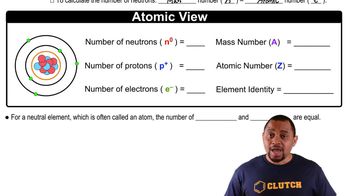
Isotopes

Isotopes are variants of a chemical element that have the same number of protons but different numbers of neutrons, resulting in different atomic masses. For bromine, the two common isotopes are bromine-79 and bromine-81. Understanding isotopes is crucial for calculating average atomic mass, as each isotope contributes to the overall mass based on its relative abundance.
Video consigliato:

Mass Spectrum

A mass spectrum is a graphical representation of the mass-to-charge ratio (m/z) of ions, which helps identify the composition of a sample. In the context of bromine, the mass spectrum shows peaks corresponding to the isotopes and their relative intensities, which indicate their abundance. Analyzing the mass spectrum is essential for determining the average atomic mass by weighing the contributions of each isotope.
Video consigliato:
Percorso guidato
02:53
Electromagnetic Spectrum

Average Atomic Mass

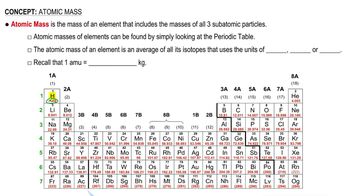
The average atomic mass of an element is calculated by taking the weighted average of the masses of its isotopes, considering their relative abundances. This value reflects the mass of a typical atom of the element found in nature. For bromine, the average atomic mass can be determined using the data from the mass spectrum, where each isotope's mass is multiplied by its relative peak intensity and summed.
Video consigliato:
Pratica correlata
Domanda del libro di testo

There are two different isotopes of bromine atoms. Under normal conditions, elemental bromine consists of molecules, and the mass of a molecule is the sum of the masses of the two atoms in the molecule. The mass spectrum of consists of three peaks: m/zRelative Peak Intensity157.836 0.2569 159.834 0.4999 161.832 0.2431

e. Calculate the abundances of the two isotopes.

2
views
Domanda del libro di testo

There are two different isotopes of bromine atoms. Under normal conditions, elemental bromine consists of molecules, and the mass of a molecule is the sum of the masses of the two atoms in the molecule. The mass spectrum of consists of three peaks: m/zRelative Peak Intensity157.836 0.2569 159.834 0.4999 161.832 0.2431

b. What is the mass of each isotope?

2
views
Domanda del libro di testo

From the following list of elements—Ar, H, Ga, Al, Ca, Br, Ge, K, O—pick the one that best fits each description. Use each element only once: (a) an alkali metal, (b) an alkaline earth metal, (c) a noble gas, (d) a halogen, (e) a metalloid, (f) a nonmetal listed in group 1A, (g) a metal that forms a 3+ ion, (h) a nonmetal that forms a 2- ion, (i) an element that resembles aluminum.

2
views
Domanda del libro di testo

There are two different isotopes of bromine atoms. Under normal conditions, elemental bromine consists of molecules, and the mass of a molecule is the sum of the masses of the two atoms in the molecule. The mass spectrum of consists of three peaks: m/zRelative Peak Intensity157.836 0.2569 159.834 0.4999 161.832 0.2431

c. Determine the average molecular mass of a molecule.

2
views
Domanda del libro di testo

It is common in mass spectrometry to assume that the mass of a cation is the same as that of its parent atom. (b) What percentage of the mass of an 1H atom does the electron represent?

305
views
Domanda del libro di testo

There are two different isotopes of bromine atoms. Under normal conditions, elemental bromine consists of molecules, and the mass of a molecule is the sum of the masses of the two atoms in the molecule. The mass spectrum of consists of three peaks: m/zRelative Peak Intensity157.836 0.2569 159.834 0.4999 161.832 0.2431

a. What is the origin of each peak (of what isotopes does each consist)?

3
views