Ch.2 - Atoms, Molecules, and Ions
Brown - Chemistry: The Central Science 15th Edition
Brown15th EditionChemistry: The Central ScienceISBN: 9780137542970Non è quello che usi tu?Cambia libro di testo
Capitolo 2, Problema 66a

Predict whether each of the following compounds is molecular or ionic. a. PF5

Guida verificata passo dopo passo
1
Identify the elements involved in the compound: PF₅ consists of phosphorus (P) and fluorine (F).
Determine the type of elements: Phosphorus is a non-metal, and fluorine is also a non-metal.
Recall the general rule: Compounds formed between non-metals are typically molecular (covalent), while compounds formed between metals and non-metals are typically ionic.
Since both phosphorus and fluorine are non-metals, PF₅ is likely to be a molecular compound.
Conclude that PF₅ is a molecular compound because it is formed by the sharing of electrons between non-metal atoms.

Risposta video verificata per un problema simile:

Questa soluzione video è stata consigliata dai nostri tutor come utile per risolvere questo problema.
Durata del video:
7m

Concetti chiave

Ecco i concetti essenziali che devi comprendere per rispondere correttamente alla domanda.

Ionic vs. Molecular Compounds

Ionic compounds are formed from the electrostatic attraction between positively and negatively charged ions, typically involving a metal and a nonmetal. In contrast, molecular compounds consist of molecules formed by covalent bonds, where atoms share electrons, usually involving nonmetals. Understanding the distinction helps in predicting the properties and structures of compounds.
Video consigliato:
Percorso guidato
02:11
Ionic Compounds Naming

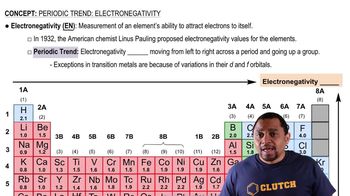
Electronegativity

Electronegativity is a measure of an atom's ability to attract and hold onto electrons in a bond. In general, a large difference in electronegativity between two atoms indicates an ionic bond, while a small difference suggests a covalent bond. For example, in PF5, the electronegativity of phosphorus and fluorine can help determine the nature of the compound.
Video consigliato:
Percorso guidato
02:10
Electronegativity Trends

Lewis Structures

Lewis structures are diagrams that represent the bonding between atoms in a molecule and the lone pairs of electrons that may exist. They are useful for visualizing how atoms are connected and can help predict whether a compound is molecular or ionic. Drawing the Lewis structure for PF5 reveals its molecular nature, as it consists of covalent bonds between phosphorus and fluorine atoms.
Video consigliato:
Percorso guidato
04:28
Lewis Dot Structures: Ions