Ch.2 - Atoms, Molecules, and Ions
Brown - Chemistry: The Central Science 15th Edition
Brown15th EditionChemistry: The Central ScienceISBN: 9780137542970Non è quello che usi tu?Cambia libro di testo
Capitolo 2, Problema 65e

Predict whether each of the following compounds is molecular or ionic: (e) CsBr

Guida verificata passo dopo passo
1
Identify the elements in the compound CsBr: Cesium (Cs) and Bromine (Br).
Determine the type of elements: Cesium (Cs) is a metal, and Bromine (Br) is a non-metal.
Recall that ionic compounds are typically formed between metals and non-metals.
Consider the position of Cesium in the periodic table: it is an alkali metal, which are known to form ionic compounds.
Conclude that CsBr is likely an ionic compound because it consists of a metal and a non-metal.

Risposta video verificata per un problema simile:

Questa soluzione video è stata consigliata dai nostri tutor come utile per risolvere questo problema.
Durata del video:
3m

Concetti chiave

Ecco i concetti essenziali che devi comprendere per rispondere correttamente alla domanda.

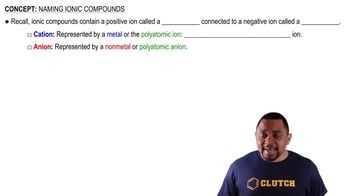
Ionic Compounds

Ionic compounds are formed when atoms transfer electrons, resulting in the formation of charged ions. Typically, these compounds consist of a metal and a non-metal, where the metal loses electrons to become a positively charged cation, and the non-metal gains electrons to become a negatively charged anion. The electrostatic attraction between these oppositely charged ions leads to the formation of a crystalline lattice structure.
Video consigliato:
Percorso guidato
02:11
Ionic Compounds Naming

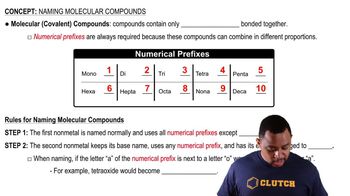
Molecular Compounds

Molecular compounds are formed when two or more non-metal atoms share electrons through covalent bonds. These compounds consist of discrete molecules, where the atoms are held together by shared pairs of electrons. Unlike ionic compounds, molecular compounds generally have lower melting and boiling points and do not conduct electricity in solution.
Video consigliato:
Percorso guidato
02:06
Naming Molecular Compounds

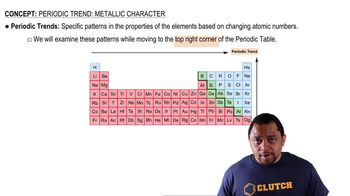
Periodic Table Trends

The periodic table organizes elements based on their atomic number and properties, revealing trends in reactivity, electronegativity, and ionization energy. Elements on the left side, such as alkali metals, tend to lose electrons easily, forming cations, while elements on the right side, such as halogens, tend to gain electrons, forming anions. Understanding these trends helps predict whether a compound will be ionic or molecular based on the types of elements involved.
Video consigliato:
Percorso guidato
00:38
Periodic Trends