Ch.21 - Nuclear Chemistry
Brown - Chemistry: The Central Science 15th Edition
Brown15th EditionChemistry: The Central ScienceISBN: 9780137542970Non è quello che usi tu?Cambia libro di testo
Capitolo 21, Problema 20a

Each of the following nuclei undergoes either beta decay or positron emission. Predict the type of emission for each: (a) tritium, 31H.

Guida verificata passo dopo passo
1
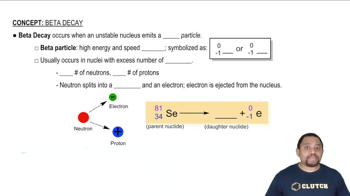
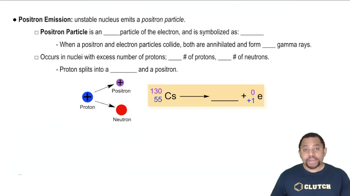
Step 1: Understand the types of decay. Beta decay occurs when a neutron in the nucleus of an atom decays into a proton and an electron (beta particle). The proton stays in the nucleus and the electron is emitted. Positron emission occurs when a proton in the nucleus decays into a neutron and a positron. The neutron stays in the nucleus and the positron is emitted.
Step 2: Look at the atomic number of the isotope. Tritium, 31H, has 1 proton and 2 neutrons.
Step 3: Consider the neutron to proton ratio. For light elements (atomic number less than 20), a 1:1 ratio of neutrons to protons is stable. Tritium has more neutrons than protons, so it is neutron-rich.
Step 4: Predict the type of decay. Neutron-rich isotopes undergo beta decay to increase the number of protons and decrease the number of neutrons, moving towards a more stable configuration.
Step 5: Therefore, tritium, 31H, undergoes beta decay.

Risposta video verificata per un problema simile:

Questa soluzione video è stata consigliata dai nostri tutor come utile per risolvere questo problema.
Durata del video:
1m

Concetti chiave

Ecco i concetti essenziali che devi comprendere per rispondere correttamente alla domanda.

Beta Decay

Beta decay is a type of radioactive decay in which a nucleus emits a beta particle, which can be an electron (beta-minus decay) or a positron (beta-plus decay). In beta-minus decay, a neutron is converted into a proton, increasing the atomic number by one, while in beta-plus decay, a proton is converted into a neutron, decreasing the atomic number by one. This process helps unstable nuclei achieve a more stable configuration.
Video consigliato:

Positron Emission

Positron emission, also known as beta-plus decay, occurs when a proton in a nucleus is transformed into a neutron, resulting in the emission of a positron (the antimatter counterpart of an electron). This process decreases the atomic number of the element by one while keeping the mass number unchanged. Positron emission is common in isotopes that are proton-rich and seek stability.
Video consigliato:
Percorso guidato
01:53
Positron Emission

Tritium

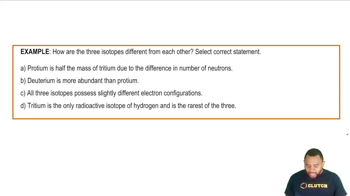
Tritium is a radioactive isotope of hydrogen with one proton and two neutrons, represented as 3H. It is unstable and undergoes beta decay to achieve stability. In the case of tritium, it emits a beta particle (electron) as it decays into helium-3, which has one less neutron, thus illustrating the process of beta-minus decay.
Video consigliato:
Percorso guidato
01:18
Hydrogen Isotopes Example