Ch.21 - Nuclear Chemistry
Brown - Chemistry: The Central Science 15th Edition
Brown15th EditionChemistry: The Central ScienceISBN: 9780137542970Non è quello che usi tu?Cambia libro di testo
Capitolo 21, Problema 19a

Predict the type of radioactive decay process for the following radionuclides: (a) 85B.

Guida verificata passo dopo passo
1
Identify the neutron-to-proton (n/p) ratio of the radionuclide. For 85B, calculate the number of neutrons: 8 (mass number) - 5 (atomic number) = 3 neutrons. The n/p ratio is 3/5.
Determine the stability of the n/p ratio. A stable n/p ratio for lighter elements is close to 1. Since 3/5 is less than 1, 85B has a low n/p ratio, indicating an excess of protons.
Consider the common decay processes. For nuclides with a low n/p ratio, positron emission or electron capture is likely, as these processes help increase the n/p ratio by converting a proton into a neutron.
Evaluate the likelihood of positron emission. Positron emission occurs when a proton is converted into a neutron, releasing a positron. This process is common in proton-rich nuclides like 85B.
Conclude that 85B is likely to undergo positron emission to achieve a more stable n/p ratio.

Risposta video verificata per un problema simile:

Questa soluzione video è stata consigliata dai nostri tutor come utile per risolvere questo problema.
Durata del video:
1m

Concetti chiave

Ecco i concetti essenziali che devi comprendere per rispondere correttamente alla domanda.

Radioactive Decay

Radioactive decay is the process by which an unstable atomic nucleus loses energy by emitting radiation. This can occur in various forms, including alpha decay, beta decay, and gamma decay, each characterized by the type of particle or energy released. Understanding the nature of the radionuclide is essential to predict the decay process it will undergo.
Video consigliato:
Percorso guidato
03:00
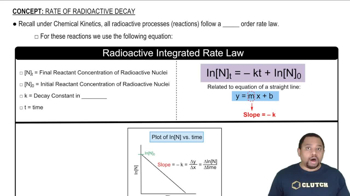
Rate of Radioactive Decay

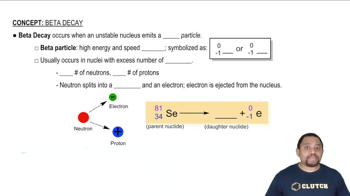
Alpha and Beta Decay

Alpha decay involves the emission of an alpha particle (two protons and two neutrons), resulting in a decrease in the atomic number by two and the mass number by four. Beta decay, on the other hand, occurs when a neutron is transformed into a proton, emitting a beta particle (an electron or positron), which increases the atomic number by one while keeping the mass number constant. Identifying the type of decay helps in understanding the stability of the radionuclide.
Video consigliato:

Nuclear Stability and the Band of Stability

The band of stability is a region on a graph of neutron number versus proton number where stable nuclei are found. Nuclei outside this band are typically unstable and will undergo radioactive decay to achieve stability. The position of a radionuclide, such as <sup>8</sup><sub>5</sub>B, in relation to this band helps predict the type of decay it will experience, guiding the analysis of its decay process.
Video consigliato:
Percorso guidato
03:29
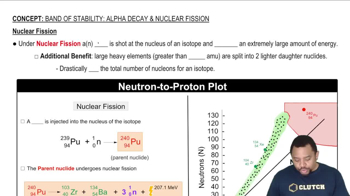
Band of Stability: Nuclear Fission