

Ch.4 - Reactions in Aqueous Solution
Brown - Chemistry: The Central Science 15th Edition
Brown15th EditionChemistry: The Central ScienceISBN: 9780137542970Non è quello che usi tu?Cambia libro di testo
Capitolo 4, Problema 88b

A solution is made by mixing 15.0 g of Sr(OH)2 and 55.0 mL of 0.200 M HNO3. b. Calculate the concentration of each ion remaining in solution.

Guida verificata passo dopo passo
1
Determine the moles of Sr(OH)_2 using its molar mass.
Calculate the moles of HNO_3 using its concentration and volume.
Write the balanced chemical equation for the reaction: Sr(OH)_2 + 2HNO_3 → Sr(NO_3)_2 + 2H_2O.
Identify the limiting reactant by comparing the mole ratio from the balanced equation.
Calculate the concentration of each ion remaining in solution by considering the stoichiometry of the reaction and the total volume of the solution.

Risposta video verificata per un problema simile:

Questa soluzione video è stata consigliata dai nostri tutor come utile per risolvere questo problema.
Durata del video:
10m

Concetti chiave

Ecco i concetti essenziali che devi comprendere per rispondere correttamente alla domanda.

Stoichiometry

Stoichiometry is the calculation of reactants and products in chemical reactions. It involves using balanced chemical equations to determine the relationships between the amounts of substances consumed and produced. In this question, stoichiometry will help in determining how much of each reactant reacts and what remains in solution after the reaction.
Video consigliato:
Percorso guidato
01:16
Stoichiometry Concept

Ion Concentration

Ion concentration refers to the amount of a specific ion present in a solution, typically expressed in molarity (M). To find the concentration of ions remaining after a reaction, one must consider the initial concentrations, the volume of the solution, and the stoichiometry of the reaction. This concept is crucial for calculating the final concentrations of Sr²⁺ and NO₃⁻ ions in the solution.
Video consigliato:
Percorso guidato
06:25
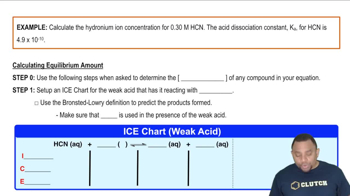
Hydronium Ion Concentration Example

Neutralization Reaction

A neutralization reaction occurs when an acid reacts with a base to produce water and a salt. In this case, HNO3 (an acid) reacts with Sr(OH)2 (a base) to form Sr(NO3)2 and water. Understanding this concept is essential for predicting the products of the reaction and determining how much of each reactant is left unreacted in the solution.
Video consigliato:
Percorso guidato
05:56
Lewis Dot Structures: Neutral Compounds