
Ch.4 - Reactions in Aqueous Solution
Brown - Chemistry: The Central Science 15th Edition
Brown15th EditionChemistry: The Central ScienceISBN: 9780137542970Non è quello che usi tu?Cambia libro di testo
Capitolo 4, Problema 87e

A solution of 100.0 mL of 0.200 M KOH is mixed with a solution of 200.0 mL of 0.150 M NiSO4. (e) What is the concentration of each ion that remains in solution?

Guida verificata passo dopo passo
1
Determine the moles of KOH: Use the formula \( \text{moles} = \text{concentration} \times \text{volume} \). Calculate the moles of KOH using the given concentration (0.200 M) and volume (100.0 mL, converted to liters).
Determine the moles of NiSO_4: Similarly, calculate the moles of NiSO_4 using its concentration (0.150 M) and volume (200.0 mL, converted to liters).
Write the balanced chemical equation: The reaction between KOH and NiSO_4 is \( 2 \text{KOH} + \text{NiSO}_4 \rightarrow \text{Ni(OH)}_2 + \text{K}_2\text{SO}_4 \).
Identify the limiting reactant: Compare the mole ratio from the balanced equation to the moles calculated to determine which reactant is limiting.
Calculate the concentration of remaining ions: After the reaction, calculate the concentration of ions that remain in solution by considering the excess reactant and the total volume of the solution (300.0 mL).

Risposta video verificata per un problema simile:

Questa soluzione video è stata consigliata dai nostri tutor come utile per risolvere questo problema.
Durata del video:
9m

Concetti chiave

Ecco i concetti essenziali che devi comprendere per rispondere correttamente alla domanda.

Molarity

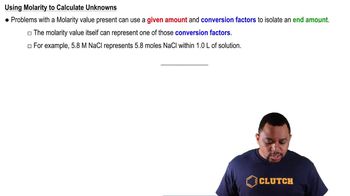
Molarity (M) is a measure of concentration defined as the number of moles of solute per liter of solution. It is crucial for calculating the amount of ions present in a solution after mixing. In this question, the molarity of KOH and NiSO4 solutions will help determine the final concentrations of K+, OH-, Ni2+, and SO4^2- ions in the combined solution.
Video consigliato:

Stoichiometry of Reactions

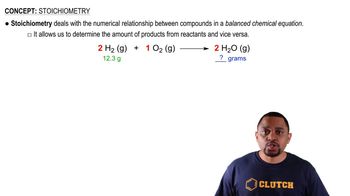
Stoichiometry involves the calculation of reactants and products in chemical reactions based on balanced equations. In this case, KOH dissociates into K+ and OH- ions, while NiSO4 dissociates into Ni2+ and SO4^2- ions. Understanding the stoichiometry allows us to determine how the ions interact and what remains in solution after mixing.
Video consigliato:
Percorso guidato
01:16
Stoichiometry Concept

Dilution and Volume Changes

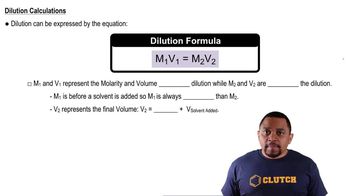
When two solutions are mixed, the total volume changes, affecting the concentration of the ions present. The dilution principle states that the concentration of a solute decreases when the volume of the solution increases. In this scenario, calculating the final concentrations of the ions requires accounting for the total volume after mixing the two solutions.
Video consigliato:
Percorso guidato
00:58
Dilution Equation
Pratica correlata
Domanda del libro di testo

A 0.5895-g sample of impure magnesium hydroxide is dissolved in 100.0 mL of 0.2050 M HCl solution. The excess acid then needs 19.85 mL of 0.1020 M NaOH for neutralization. Calculate the percentage by mass of magnesium hydroxide in the sample, assuming that it is the only substance reacting with the HCl solution.

1379
views
1
rank
Domanda del libro di testo

A solution of 100.0 mL of 0.200 M KOH is mixed with a solution of 200.0 mL of 0.150 M NiSO4. (a) Write the balanced chemical equation for the reaction that occurs.

407
views
Domanda del libro di testo

A solution is made by mixing 15.0 g of Sr(OH)2 and 55.0 mL of 0.200 M HNO3. b. Calculate the concentration of each ion remaining in solution.

3
views
Domanda del libro di testo

A solution of 100.0 mL of 0.200 M KOH is mixed with a solution of 200.0 mL of 0.150 M NiSO4. (b) What precipitate forms?

383
views
Domanda del libro di testo

A solution is made by mixing 15.0 g of Sr(OH)2 and 55.0 mL of 0.200 M HNO3. c. Is the resulting solution acidic or basic?


Domanda del libro di testo

An 8.65-g sample of an unknown group 2 metal hydroxide is dissolved in 85.0 mL of water. An acid–base indicator is added and the resulting solution is titrated with 2.50 M HCl(aq) solution. The indicator changes color, signaling that the equivalence point has been reached, after 56.9 mL of the hydrochloric acid solution has been added. (a) What is the molar mass of the metal hydroxide? (b) What is the identity of the metal cation: Ca2+, Sr2+, or Ba2+?

1120
views