
Ch.4 - Reactions in Aqueous Solution
Brown - Chemistry: The Central Science 15th Edition
Brown15th EditionChemistry: The Central ScienceISBN: 9780137542970Non è quello che usi tu?Cambia libro di testo
Capitolo 4, Problema 86

An 8.65-g sample of an unknown group 2 metal hydroxide is dissolved in 85.0 mL of water. An acid–base indicator is added and the resulting solution is titrated with 2.50 M HCl(aq) solution. The indicator changes color, signaling that the equivalence point has been reached, after 56.9 mL of the hydrochloric acid solution has been added. (a) What is the molar mass of the metal hydroxide? (b) What is the identity of the metal cation: Ca2+, Sr2+, or Ba2+?

Guida verificata passo dopo passo
1
Determine the moles of HCl used in the titration by using the formula: \( \text{moles of HCl} = \text{volume (L)} \times \text{molarity (M)} \). Convert the volume of HCl from mL to L before using it in the calculation.
Write the balanced chemical equation for the reaction between the group 2 metal hydroxide \( M(OH)_2 \) and HCl: \( M(OH)_2 + 2 \text{HCl} \rightarrow MCl_2 + 2 \text{H}_2\text{O} \).
Use the stoichiometry of the balanced equation to determine the moles of \( M(OH)_2 \) that reacted. Since 2 moles of HCl react with 1 mole of \( M(OH)_2 \), divide the moles of HCl by 2 to find the moles of \( M(OH)_2 \).
Calculate the molar mass of the unknown metal hydroxide \( M(OH)_2 \) using the formula: \( \text{molar mass} = \frac{\text{mass of sample (g)}}{\text{moles of } M(OH)_2} \).
Compare the calculated molar mass of \( M(OH)_2 \) with the known molar masses of \( \text{Ca(OH)}_2 \), \( \text{Sr(OH)}_2 \), and \( \text{Ba(OH)}_2 \) to identify the metal cation.

Risposta video verificata per un problema simile:

Questa soluzione video è stata consigliata dai nostri tutor come utile per risolvere questo problema.
Durata del video:
7m

Concetti chiave

Ecco i concetti essenziali che devi comprendere per rispondere correttamente alla domanda.

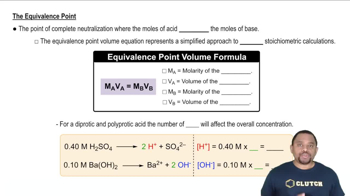
Titration and Equivalence Point

Titration is a quantitative analytical method used to determine the concentration of a solute in a solution. The equivalence point is reached when the amount of titrant added is stoichiometrically equivalent to the amount of substance in the sample. In this case, the color change of the indicator signals that all the metal hydroxide has reacted with the hydrochloric acid, allowing for calculations to determine the identity of the metal cation.
Video consigliato:
Percorso guidato
03:06
Equivalence Point in Titration

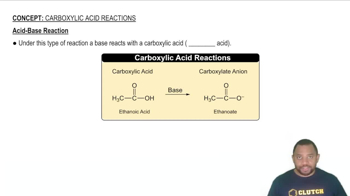
Stoichiometry of Acid-Base Reactions

Stoichiometry involves the calculation of reactants and products in chemical reactions based on balanced equations. For the reaction between a metal hydroxide and hydrochloric acid, the stoichiometric coefficients indicate the molar ratios of the reactants. Understanding these ratios is essential to determine the number of moles of the metal hydroxide present, which can then be used to identify the metal cation based on its molar mass.
Video consigliato:
Percorso guidato
01:09
Acid-Base Reaction

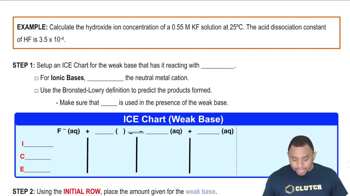
Group 2 Metal Hydroxides

Group 2 metal hydroxides, such as calcium hydroxide (Ca(OH)2), strontium hydroxide (Sr(OH)2), and barium hydroxide (Ba(OH)2), are characterized by their solubility and molar masses. Each metal hydroxide has a distinct molar mass that can be calculated from the mass of the sample and the moles of acid used in the titration. By comparing the calculated molar mass of the unknown hydroxide to known values, one can identify the specific metal cation present.
Video consigliato:
Percorso guidato
06:12
Hydroxide Ion Concentration Example
Pratica correlata
Domanda del libro di testo

The distinctive odor of vinegar is due to acetic acid, CH3COOH, which reacts with sodium hydroxide according to: CH3COOH1aq2 + NaOH1aq2¡ H2O1l2 + NaCH3COO1aq2 If 3.45 mL of vinegar needs 42.5 mL of 0.115 M NaOH to reach the equivalence point in a titration, how many grams of acetic acid are in a 1.00-qt sample of this vinegar?

1270
views
Domanda del libro di testo

A solution of 100.0 mL of 0.200 M KOH is mixed with a solution of 200.0 mL of 0.150 M NiSO4. (a) Write the balanced chemical equation for the reaction that occurs.

407
views
Domanda del libro di testo

A 4.36-g sample of an unknown alkali metal hydroxide is dissolved in 100.0 mL of water. An acid–base indicator is added, and the resulting solution is titrated with 2.50 M HCl(aq) solution. The indicator changes color, signaling that the equivalence point has been reached, after 17.0 mL of the hydrochloric acid solution has been added. (b) What is the identity of the alkali metal cation: Li+, Na+, K+, Rb+, or Cs+?

455
views
Domanda del libro di testo

A solution of 100.0 mL of 0.200 M KOH is mixed with a solution of 200.0 mL of 0.150 M NiSO4. (b) What precipitate forms?

383
views
Domanda del libro di testo

A solution of 100.0 mL of 0.200 M KOH is mixed with a solution of 200.0 mL of 0.150 M NiSO4. (e) What is the concentration of each ion that remains in solution?

998
views
Domanda del libro di testo

A 4.36-g sample of an unknown alkali metal hydroxide is dissolved in 100.0 mL of water. An acid–base indicator is added, and the resulting solution is titrated with 2.50 M HCl(aq) solution. The indicator changes color, signaling that the equivalence point has been reached, after 17.0 mL of the hydrochloric acid solution has been added. (a) What is the molar mass of the metal hydroxide?

1602
views