Ch.4 - Reactions in Aqueous Solution
Brown - Chemistry: The Central Science 15th Edition
Brown15th EditionChemistry: The Central ScienceISBN: 9780137542970Non è quello che usi tu?Cambia libro di testo
Capitolo 4, Problema 33a

State whether each of the following statements is true or false. Justify your answer in each case. (a) Sulfuric acid is a monoprotic acid.

Guida verificata passo dopo passo
1
Sulfuric acid (H_2SO_4) is a strong acid commonly used in various chemical processes.
The term 'monoprotic' refers to an acid that can donate only one proton (H^+) per molecule in an aqueous solution.
To determine if sulfuric acid is monoprotic, consider its chemical formula, H_2SO_4, which indicates it has two hydrogen atoms that can potentially be donated as protons.
In aqueous solution, sulfuric acid dissociates in two steps: the first step involves the donation of one proton, forming the bisulfate ion (HSO_4^-), and the second step involves the donation of a second proton, forming the sulfate ion (SO_4^{2-}).
Since sulfuric acid can donate two protons, it is classified as a diprotic acid, not a monoprotic acid. Therefore, the statement is false.

Risposta video verificata per un problema simile:

Questa soluzione video è stata consigliata dai nostri tutor come utile per risolvere questo problema.
Durata del video:
1m

Concetti chiave

Ecco i concetti essenziali che devi comprendere per rispondere correttamente alla domanda.

Monoprotic Acids

Monoprotic acids are acids that can donate only one proton (H⁺ ion) per molecule during the process of dissociation in an aqueous solution. This characteristic is crucial for understanding the acid's strength and behavior in chemical reactions. Examples of monoprotic acids include hydrochloric acid (HCl) and acetic acid (CH₃COOH).
Video consigliato:

Sulfuric Acid

Sulfuric acid (H₂SO₄) is a strong diprotic acid, meaning it can donate two protons per molecule. The first dissociation releases one proton, while the second dissociation releases another proton, making it capable of acting as both a monoprotic and diprotic acid depending on the context. This property is essential for understanding its reactivity and applications in various chemical processes.
Video consigliato:

Acid Strength and Classification

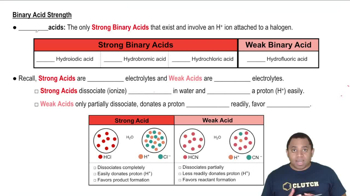
Acid strength refers to the ability of an acid to donate protons in solution, which is influenced by its molecular structure and the stability of its conjugate base. Acids are classified as strong or weak based on their degree of ionization in water. Understanding this classification helps in predicting the behavior of acids in chemical reactions and their interactions with bases.
Video consigliato:
Percorso guidato
03:51
Binary Acid Strengths