Ch.4 - Reactions in Aqueous Solution
Brown - Chemistry: The Central Science 15th Edition
Brown15th EditionChemistry: The Central ScienceISBN: 9780137542970Non è quello che usi tu?Cambia libro di testo
Capitolo 4, Problema 33c

State whether each of the following statements is true or false. Justify your answer in each case. (c) Methanol is a base.

Guida verificata passo dopo passo
1
Identify the chemical structure of methanol, which is CH3OH. It consists of a hydroxyl group (-OH) attached to a methyl group (CH3).
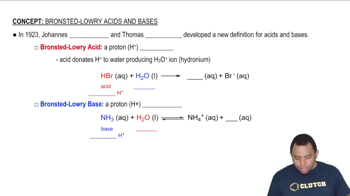
Understand the definition of a base in the context of the Brønsted-Lowry theory, which defines a base as a substance that can accept a proton (H+).
Analyze the ability of methanol to accept a proton. Focus on the hydroxyl group, as it is the functional group that might interact with protons.
Consider the typical behavior of alcohols (like methanol) in chemical reactions. Alcohols generally do not accept protons but can donate the proton from the hydroxyl group, acting as acids in some reactions.
Conclude whether methanol fits the criteria of a Brønsted-Lowry base based on its chemical behavior and interaction with protons.

Risposta video verificata per un problema simile:

Questa soluzione video è stata consigliata dai nostri tutor come utile per risolvere questo problema.
Durata del video:
2m

Concetti chiave

Ecco i concetti essenziali che devi comprendere per rispondere correttamente alla domanda.

Acid-Base Theory

Acid-base theory explains the behavior of substances in terms of proton (H+) transfer. According to the Brønsted-Lowry theory, acids are proton donors, while bases are proton acceptors. Understanding this theory is essential for determining whether a substance, like methanol, acts as an acid or a base in a chemical reaction.
Video consigliato:
Percorso guidato
02:08
Bronsted-Lowry Acid-Base Theory

Properties of Alcohols

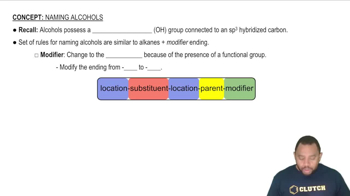
Methanol is an alcohol, characterized by the presence of a hydroxyl (-OH) group. Alcohols typically exhibit weak acidic properties due to the ability of the hydroxyl group to donate protons, but they do not generally function as bases. Recognizing the properties of alcohols helps in assessing their behavior in acid-base reactions.
Video consigliato:
Percorso guidato
01:10
Rules for Naming Alcohols

Solvent Effects on Acid-Base Behavior

The solvent can significantly influence the acid-base behavior of a substance. In aqueous solutions, methanol can act as a weak acid but does not readily accept protons, which is a key characteristic of bases. Understanding the role of solvents is crucial for evaluating the acid-base properties of compounds like methanol.
Video consigliato:
Percorso guidato
00:33
Common Ion Effect in Acids and Bases