Ch.5 - Thermochemistry
Brown - Chemistry: The Central Science 15th Edition
Brown15th EditionChemistry: The Central ScienceISBN: 9780137542970Non è quello che usi tu?Cambia libro di testo
Capitolo 5, Problema 12b

(b) Why does increasing the temperature cause a solid substance to change in succession from a solid to a liquid to a gas?

Guida verificata passo dopo passo
1
1. The process of a solid changing to a liquid and then to a gas involves the addition of heat energy. This is because heat energy is required to overcome the forces of attraction between the particles in the solid.
2. When a solid is heated, the kinetic energy of its particles increases. This causes the particles to vibrate more vigorously, which weakens the forces of attraction holding them in fixed positions. As a result, the solid melts and becomes a liquid.
3. If the liquid is heated further, the kinetic energy of the particles continues to increase. This causes the particles to move even faster, breaking the forces of attraction between them completely. As a result, the liquid boils and becomes a gas.
4. In summary, increasing the temperature of a substance adds energy to its particles. This energy is used to overcome the forces of attraction between the particles, causing the substance to change from a solid to a liquid to a gas.
5. This process is known as phase transition, and it's a fundamental concept in the study of matter and its properties in chemistry.

Risposta video verificata per un problema simile:

Questa soluzione video è stata consigliata dai nostri tutor come utile per risolvere questo problema.
Durata del video:
1m

Concetti chiave

Ecco i concetti essenziali che devi comprendere per rispondere correttamente alla domanda.

Kinetic Molecular Theory

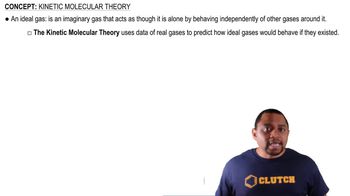
The Kinetic Molecular Theory explains the behavior of particles in different states of matter. It posits that as temperature increases, the kinetic energy of particles also increases, causing them to move more vigorously. This increased motion leads to the breaking of intermolecular forces, allowing solids to melt into liquids and liquids to vaporize into gases.
Video consigliato:
Percorso guidato
01:19
Kinetic Molecular Theory

Phase Changes

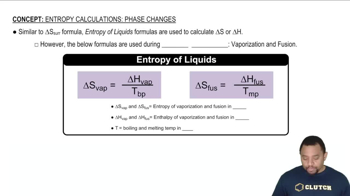
Phase changes refer to the transitions between solid, liquid, and gas states of matter. These changes occur at specific temperatures known as melting and boiling points. When a solid is heated, it absorbs energy, which facilitates the transition to a liquid state, and further heating allows the liquid to transition to a gaseous state.
Video consigliato:
Percorso guidato
01:46
Entropy in Phase Changes

Intermolecular Forces

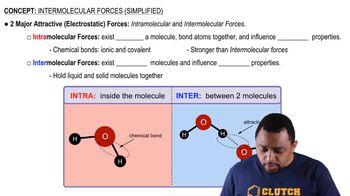
Intermolecular forces are the attractive forces between molecules that influence the physical properties of substances. In solids, these forces are strong, keeping particles closely packed. As temperature rises, these forces weaken, enabling the solid to melt into a liquid and eventually allowing the liquid to evaporate into a gas.
Video consigliato:
Percorso guidato
01:59
Intermolecular vs Intramolecular Forces