
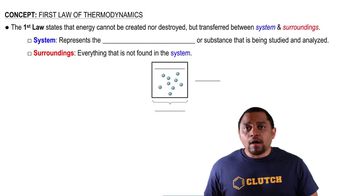
Imagine a container placed in a tub of water, as depicted in the accompanying diagram. (a) If the contents of the container are the system and heat is able to flow through the container walls, what qualitative changes will occur in the temperatures of the system and in its surroundings? From the system's perspective, is the process exothermic or endothermic?
Ch.5 - Thermochemistry

Brown15th EditionChemistry: The Central ScienceISBN: 9780137542970Non è quello che usi tu?Cambia libro di testo
Capitolo 5, Problema 8a
In the accompanying cylinder diagram, a chemical process occurs at constant temperature and pressure. (a) Is the sign of w indicated by this change positive or negative?
Guida verificata passo dopo passo1
insert step 1> Identify the type of process occurring in the cylinder. Since the process occurs at constant temperature and pressure, it is likely an isothermal process.
insert step 2> Recall that work (w) in thermodynamics is related to the expansion or compression of gases. In an isothermal process, work is done by or on the system.
insert step 3> Determine the direction of the process. If the gas expands, it does work on the surroundings, and if it is compressed, work is done on the gas.
insert step 4> Use the sign convention for work: If the system does work on the surroundings (expansion), w is negative. If work is done on the system (compression), w is positive.
insert step 5> Based on the direction of the process (expansion or compression), determine the sign of w.

Risposta video verificata per un problema simile:
Questa soluzione video è stata consigliata dai nostri tutor come utile per risolvere questo problema.
Durata del video:
7mConcetti chiave
Ecco i concetti essenziali che devi comprendere per rispondere correttamente alla domanda.
Work (w) in Thermodynamics
In thermodynamics, work (w) refers to the energy transferred when a force is applied over a distance. The sign of work is determined by the direction of energy transfer: positive work indicates that the system is doing work on the surroundings, while negative work means that work is done on the system by the surroundings.
Video consigliato:
Percorso guidato
First Law of Thermodynamics
Constant Temperature and Pressure
A process occurring at constant temperature and pressure is known as an isothermal and isobaric process, respectively. In such conditions, the system's internal energy remains constant, and any energy change is associated with work done or heat exchanged, which influences the sign of work.
Video consigliato:
Percorso guidato
Standard Temperature and Pressure
First Law of Thermodynamics
The First Law of Thermodynamics states that energy cannot be created or destroyed, only transformed. It relates the change in internal energy of a system to the heat added to the system and the work done by the system, expressed as ΔU = Q - w. Understanding this relationship is crucial for determining the sign of work in a given process.
Video consigliato:
Percorso guidato
First Law of Thermodynamics
Pratica correlata
Domanda del libro di testo
385
views
Domanda del libro di testo
The diagram shows four states of a system, each with different internal energy, E. (c) Write an expression for the difference in energy between State C and State D.
1106
views
Domanda del libro di testo
Consider the two diagrams that follow. (d) Would similar relationships hold for the work involved in each process?
387
views
Domanda del libro di testo
The diagram shows four states of a system, each with different internal energy, E. (a) Which of the states of the system has the greatest internal energy?
443
views
1
rank
Domanda del libro di testo
(b) Why does increasing the temperature cause a solid substance to change in succession from a solid to a liquid to a gas?
392
views
