
Ch.6 - Electronic Structure of Atoms
Brown - Chemistry: The Central Science 15th Edition
Brown15th EditionChemistry: The Central ScienceISBN: 9780137542970Non è quello che usi tu?Cambia libro di testo
Capitolo 6, Problema 14

Carbon dioxide in the atmosphere absorbs energy in the 4.0–4.5 mm range of the spectrum. (a) Calculate the frequency of the 4.0 mm radiation.

Guida verificata passo dopo passo
1
Step 1: Understand the relationship between wavelength and frequency. The speed of light (c) is related to wavelength (\( \lambda \)) and frequency (\( \nu \)) by the equation \( c = \lambda \nu \).
Step 2: Identify the given values. The wavelength (\( \lambda \)) is given as 4.0 mm. Convert this wavelength from millimeters to meters for consistency with the speed of light units. Recall that 1 mm = 1 \(\times\) 10^{-3} m.
Step 3: Use the speed of light constant. The speed of light (c) is approximately \( 3.00 \times 10^8 \) meters per second.
Step 4: Rearrange the equation to solve for frequency (\( \nu \)). The formula becomes \( \nu = \frac{c}{\lambda} \).
Step 5: Substitute the values into the equation. Use the converted wavelength in meters and the speed of light to calculate the frequency.

Concetti chiave

Ecco i concetti essenziali che devi comprendere per rispondere correttamente alla domanda.

Electromagnetic Spectrum

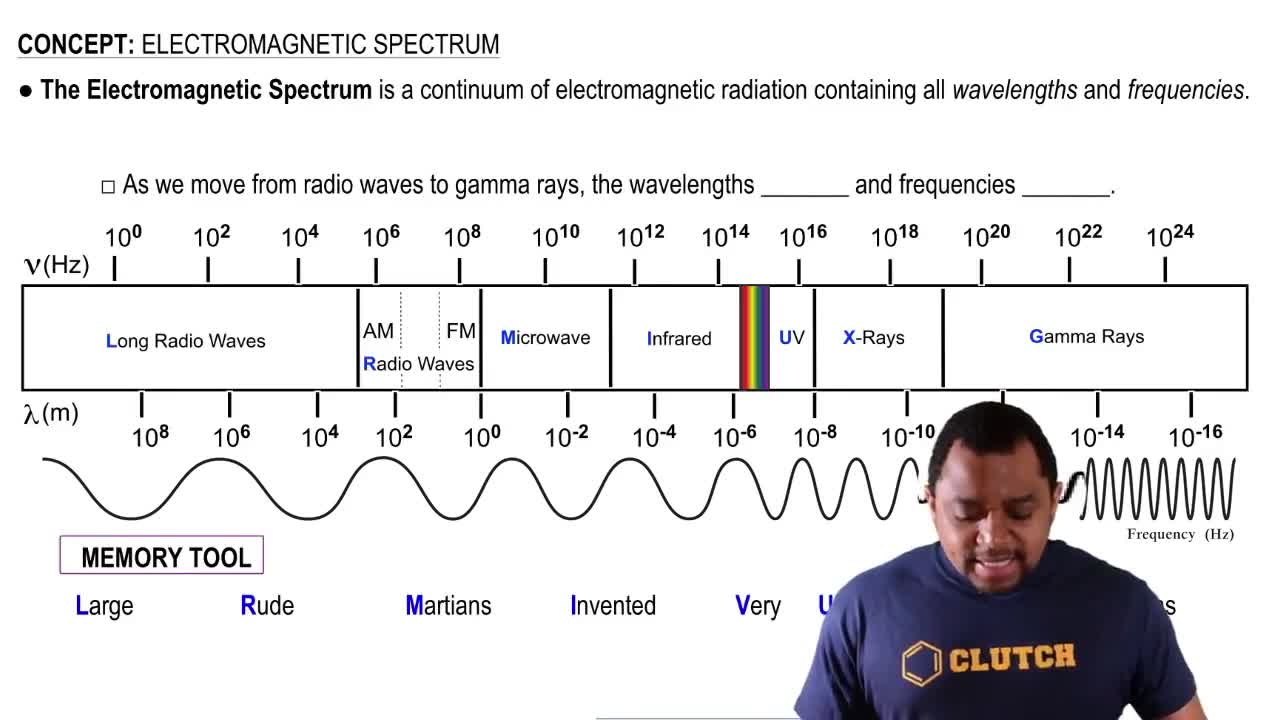
The electromagnetic spectrum encompasses all types of electromagnetic radiation, which vary in wavelength and frequency. The range of 4.0 mm falls within the infrared region of the spectrum, where radiation is primarily associated with thermal energy. Understanding the position of this wavelength helps in analyzing how different gases, like carbon dioxide, interact with infrared radiation.
Video consigliato:
Percorso guidato
02:53
Electromagnetic Spectrum

Wavelength and Frequency Relationship

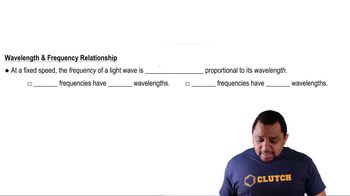
Wavelength and frequency are inversely related properties of electromagnetic waves, described by the equation c = λν, where c is the speed of light, λ is the wavelength, and ν is the frequency. This relationship allows us to calculate the frequency of radiation when the wavelength is known. For example, to find the frequency of 4.0 mm radiation, one would convert the wavelength to meters and apply the equation.
Video consigliato:
Percorso guidato
00:31
Frequency-Wavelength Relationship

Units of Measurement

In physics and chemistry, it is crucial to use consistent units when performing calculations. Wavelength is often measured in meters (m), while frequency is measured in hertz (Hz). Converting millimeters to meters is necessary for accurate calculations, as 1 mm equals 0.001 m. This ensures that the results are in standard SI units, facilitating clear communication and understanding in scientific contexts.
Video consigliato:
Percorso guidato
02:52
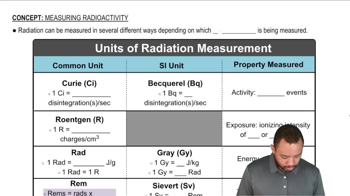
Units of Radiation Measurement